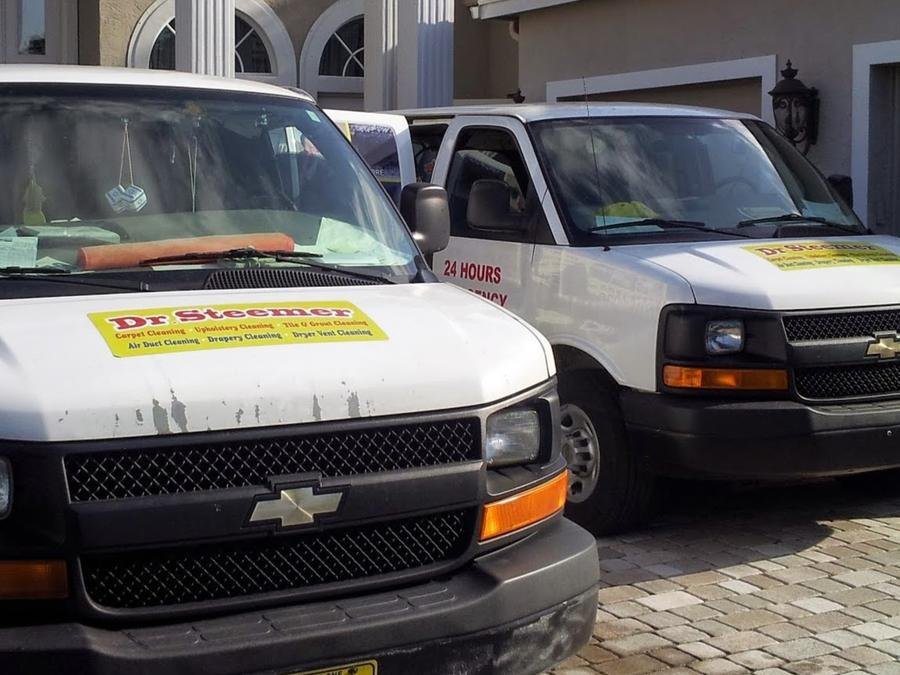
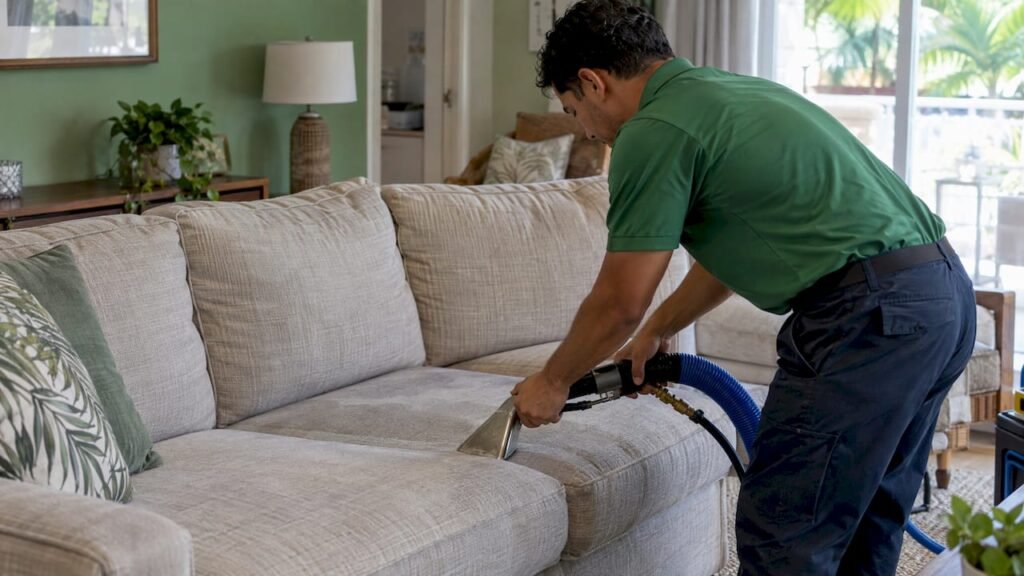
In Hollywood, upholstery cleaning works best when a certified technician inspects the fabric, matches the method to its care code and removes the moisture properly afterward. South Florida’s humidity makes that last step matter more than it does elsewhere. We at Dr. Steemer serve Broward County with IICRC-certified technicians, a 21-day satisfaction guarantee and same-day or next-day booking. This guide explains what a professional job involves, so you know what to ask for, what to do before we arrive and what to expect afterward.
TL;DR
- Check the care tag on your sofa or chair before anything else. The code (W, S, WS or X) decides which cleaning method is safe.
- A proper professional job starts with an inspection and a fabric test, not with a machine. The IICRC S300 standard requires both.
- Pet urine can soak below the fabric into the cushion filling, so tell the technician about every accident, old or new.
- Plan to have upholstery professionally cleaned every 12 to 24 months, more often with pets, children or heavy use.
- We publish no flat upholstery price. Quotes depend on the piece, fabric and condition, and you can book same-day or next-day in Hollywood and the rest of Broward.
Table of Contents
- Why upholstery cleaning is different in Hollywood
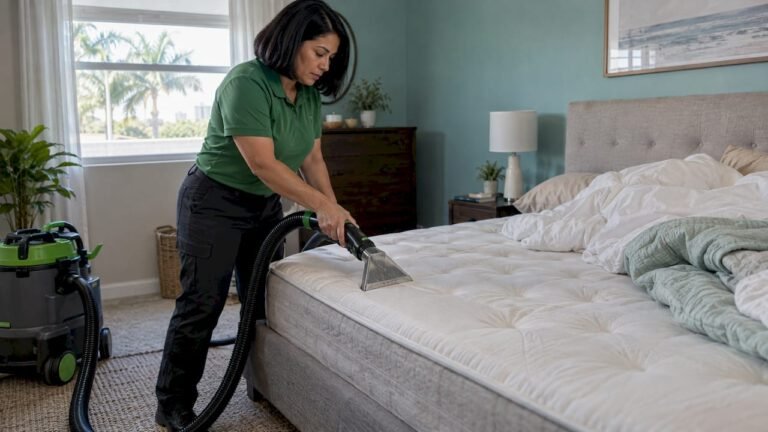
- What professional upholstery cleaning involves
- Read your care tag: W, S, WS and X
- Cleaning in place, and what to prepare
- Pet stains, odors and allergens
- How often to clean upholstery
- What upholstery cleaning costs
- Which furniture can be cleaned
- Book upholstery cleaning in Hollywood
- Our perspective
- Frequently asked questions
- Sources
Why upholstery cleaning is different in Hollywood
A sofa in Hollywood lives in warm, humid air for most of the year. Fabric absorbs that moisture, along with skin oils, food, sunscreen, pet dander and whatever walks in on shoes and paws. Soil bonds to fibers that are slightly damp, and slow drying can leave a musty smell or stains that reappear.
The humidity matters for drying too. The University of Georgia’s extension service, repeating EPA guidance, recommends keeping indoor humidity below 60%, ideally between 30 and 50%, because moisture left in a home can lead to mold growth. A freshly cleaned sofa in a closed, humid living room is exactly the situation that guidance is about. That is why extraction, airflow and air conditioning are part of the job, not an afterthought.
We built our process around South Florida’s climate for this reason. We remove as much water as possible during cleaning and then help the piece dry quickly.
What professional upholstery cleaning involves
The procedural reference for the trade is the ANSI/IICRC S300 standard for upholstery cleaning, whose 2025 second edition covers fibers and construction, equipment, inspections, methods, leather, spot and stain removal and fabric protectors. IICRC is the certifying body behind the credential our technicians hold. Here is how the work typically runs.
1. Interview and inspection
The standard calls for a written pre-cleaning inspection and a customer interview covering the fiber type, the age of the piece, how it has been maintained, pets, existing defects and what you expect. Be specific. “The left arm has a coffee stain from last spring” helps more than “it needs a clean.”
2. Fabric identification and testing
The same standard requires colorfastness and fiber tests in an inconspicuous spot, regardless of what the manufacturer’s label says. A dye that bleeds on a hidden skirt panel tells the technician to change the method before a visible cushion is touched.
3. Pre-vacuuming and spot treatment
Dry soil comes out first. Loose grit left in the fabric turns to mud once water is added. Stains are then treated individually, since a grease spot, a wine spill and a pet accident each need different chemistry.
4. Cleaning and extraction
The IICRC view is that method selection, not product strength, determines safe results. Cleaner pH has to suit the fiber, heat and agitation have to be moderated for natural fibers such as wool, silk and linen, and the cleaning solution needs dwell time to loosen soil before it is extracted. Rinsing and extracting the soil, rather than leaving residue behind, is what keeps fabric from re-soiling quickly.
5. Grooming, drying and final walk-through
The standard also calls for a post-cleaning inspection with you that covers drying time and when normal use can resume. Ask for that answer before the technician leaves, and ask where to place fans or how to set the air conditioning.
Read your care tag: W, S, WS and X
Most upholstered furniture carries a tag, usually under a seat cushion or on the frame. The Dry Cleaning and Laundry Institute explains the codes: W means water-based cleaning, S means solvent-based cleaners only, W-S means either, and X means vacuuming or brushing only, with no liquids. Using the wrong method can cause shrinking, fading or other damage.
In practice:
| Code | What it means | What it usually means for you |
|---|---|---|
| W | Water-based cleaners | Common on chenille and many synthetics. Most suitable for a full professional clean. |
| S | Solvent-based only, no water | Typical for velvets and some textured weaves. A professional using solvent agents is the recommended route. |
| WS | Water- or solvent-based | Most flexible. The technician picks based on the soil and your fabric test. |
| X | Vacuum or light brushing only | Liquids are off the table. Furniture makers advise a non-metallic stiff brush. |
Two practical points. First, tags go missing. The DLI notes that care labels are not always permanently attached, so photograph yours when you find it. Second, a code is a starting point. Bob Vila’s testing guide and the manufacturers all recommend a spot test in a hidden area, and a technician will do one anyway.
If you have a piece whose tag you cannot find, or an S or X code, this is where hiring a certified technician pays for itself. We identify the fabric and choose the method for you, so you are not guessing with a bottle of store-bought cleaner on a velvet armchair.
Cleaning in place, and what to prepare
Upholstery is normally cleaned on the furniture. The DLI explains that removing cushion covers can cause shrinkage, mismatched covers, backing damage and distortion. Even where covers zip off, leave them on unless the tag says otherwise.
Before the appointment:
- Clear the area. Remove pillows, throws, toys and anything on or around the piece, and make a path from the door.
- Empty the pockets. Check between cushions for coins, pens and food.
- Note problem spots. Mark stains with a sticky note or tell the technician. Include the cause and how long ago it happened.
- Locate the care tag and any past cleaning records, including whether a fabric protector was applied.
- Skip home remedies on the day. Mixing your own products with a professional’s chemistry can set stains or leave residue, so tell the technician what you already tried.
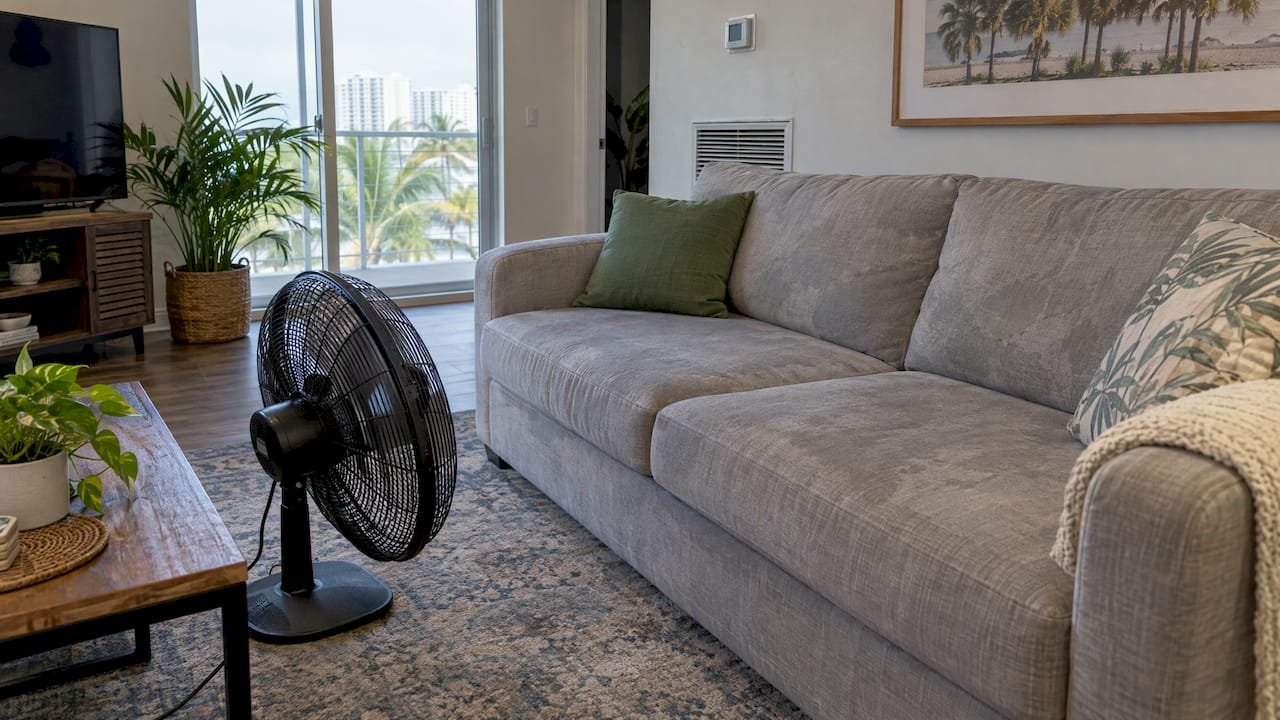
- Plan for drying. Keep pets and children off the piece and have the air conditioning running.
How long does upholstery take to dry?
There is no single number, because drying depends on the method, the fabric, cushion thickness and the humidity in the room. Properly extracted fabric is typically damp rather than wet when the technician finishes. Thick foam cushions and heavy weaves hold more moisture. Good airflow and a cool, dry room shorten the wait. We give you a drying estimate for your specific piece, and the IICRC standard expects that conversation to happen at the final inspection. Stay off the furniture until the technician says it is ready, and keep fabric away from direct heat, which can stress delicate fibers.
Pet stains, odors and allergens
Pet owners have the hardest case. The IICRC’s consumer tip sheet explains that urine odors may penetrate beneath the fabric into fiberfill, down and structural materials. A technician can inject odor treatments, but no one can see whether they reach every deposit. Heavily contaminated seat and pillow cores may need replacing, and the client has to accept the risk of hidden staining before treatment.
That is an honest reason to call early. A fresh accident is far easier to treat than one that has been soaking into a cushion for weeks. To help us:
- Blot, never rub, and do not saturate the spot.
- Tell the technician where and when each accident happened, including old ones you only smell in humid weather.
- Mention every pet, and any family member with allergies or asthma.
Our cleaning uses eco-friendly, pet-safe solutions, which matters in a home where children and animals sleep on the sofa. Extraction also removes dust and dander from the fabric surface, which is part of why people notice the room smells fresher.
Browning and fabric protectors
Two more things the IICRC tip sheet covers. Linen and cotton can develop cellulosic browning, a yellow-to-brown discoloration when plant-based fibers get wet and dry slowly. It advises contacting an IICRC-certified technician instead of trying to fix it yourself. In a humid city, that is one more reason to let a professional control the moisture and drying.
On protectors, the same source says they do not make liquids bead permanently or fill the weave. What they do is make vacuuming more effective, give you more time to blot a spill and improve the results of scheduled cleaning. Think of a protector as an ally for routine care and not as a force field.
How often to clean upholstery
The IICRC S300 draft says upholstery should be maintained monthly and professionally cleaned at least every 12 to 24 months, depending on use, soiling and location. Neglected pieces may need more aggressive restorative cleaning.
A simple schedule for Hollywood households:
- Monthly: vacuum seats, backs, arms and crevices, and rotate and flip removable cushions if the piece is designed for it.
- Every 12 months: families with pets or children, sofas used daily, pieces near sliding doors or kitchens, and anyone with allergies.
- Every 18 to 24 months: lightly used formal furniture and guest-room chairs.
- Right away: after any pet accident, spill, flood or water intrusion.
For offices, waiting rooms and rental units, schedules are tighter because of traffic. Our page on commercial upholstery cleaning methods, schedules and pricing covers how property managers set them up.
What upholstery cleaning costs
We do not publish a flat price for upholstery cleaning, because the right quote depends on the piece, the fabric, the soil level and any odor treatment. For a national reference point, Homewyse’s January 2026 calculator estimates that basic professional upholstery cleaning in the US starts at $189 to $245 per item, including labor, supplies and equipment, with a 2-hour minimum labor charge. That is a US-wide estimate, not our quote.
What moves the price:
- Size and construction. A loveseat is not a sectional, and tufting and pleats take longer.
- Fabric. Delicate or solvent-only fabrics take more careful work.
- Condition. Heavy soil, pet urine and old stains call for more steps.
- Number of pieces. Cleaning several items in one visit is usually more efficient than separate trips.
For a more local view, see our guide to upholstery cleaning cost in Miami, which breaks down what drives a quote across South Florida.
Which furniture can be cleaned
Most household and commercial seating can be professionally cleaned: sofas, loveseats, sectionals, recliners, dining chairs, accent chairs and headboards. Each has quirks. Dining chairs soak up food and grease at the seat edge, and recliners trap skin oils at the headrest. We cover specifics in our guides to chair upholstery cleaning, codes and steps and furniture deep cleaning. Bedroom pieces such as mattresses are a separate service on our mattress cleaning page.
If your living room also has carpet, area rugs or drapes, they hold the same dust and humidity. Booking them in one visit is convenient, and we clean carpets, area rugs and drapery as well.
Book upholstery cleaning in Hollywood
We serve homes and businesses across Broward, Miami-Dade and Palm Beach counties. For Hollywood, you can read about our nearby service on the Fort Lauderdale upholstery cleaning page. Our technicians are IICRC-certified, our products are eco-friendly and pet-safe, and every job is backed by a 21-day satisfaction guarantee. Same-day and next-day booking is available when a spill or a guest visit cannot wait.
To get a quote, send us the type of piece, the fabric tag if you can find it and a photo of the problem areas. You can start on our upholstery cleaning page.
Our perspective
Most upholstery damage we hear about does not come from dirt. It comes from the wrong method applied with good intentions: a water-based cleaner on a fabric coded S, too much moisture on a thick cushion in July, or a stain rubbed deeper into the weave.
That is why we start with the tag, the fabric test and the questions, and why IICRC certification matters to us. Certified training teaches the chemistry and moisture control that the S300 standard is built on. In Hollywood and the rest of South Florida, we also tailor the process to the humidity, because a piece that dries slowly is a piece that can smell or brown.
Our eco-friendly, pet-safe approach is designed for homes where people and animals sit on the furniture every day. And because we back every job with a 21-day satisfaction guarantee, we want you to tell us if something is not right.
Dr
Frequently asked questions
Can all upholstery be steam cleaned?
No. The care code on the tag decides the method. W and WS fabrics generally accept water-based cleaning, S fabrics need solvent-based products and X fabrics can only be vacuumed or lightly brushed. A certified technician tests the fabric first and chooses the method that suits it.
Will cleaning remove pet urine odor from my sofa?
Often, especially when treated soon. Urine can travel below the fabric into the cushion filling, and the IICRC notes that a technician cannot confirm every deposit is reached. Tell us about every accident so we can plan the right treatment, and call as early as possible.
How soon can I use my furniture after cleaning?
It depends on the fabric, cushion thickness and the humidity in your home. The technician should give you a drying estimate at the final walk-through. Keep the air conditioning running and keep pets and children off the piece until it is ready.
How often should I have upholstery professionally cleaned?
The IICRC’s S300 draft recommends every 12 to 24 months, depending on use and soiling. Households with pets, children or allergies tend to sit at the shorter end. Vacuum monthly in between.
Do you offer same-day upholstery cleaning in Hollywood?
We offer same-day and next-day booking across Broward, Miami-Dade and Palm Beach counties, depending on availability. Contact us with the piece and fabric details and we will confirm what is open.
Sources
- IICRC S300 standard overview
- IICRC S300 Standard for Professional Upholstery Cleaning, public-review draft
- IICRC Consumer Floor and Furnishings Care Information: Upholstery
- Dry Cleaning and Laundry Institute International: Household
- Frontgate upholstery cleaning and care codes
- Bob Vila: The Best Upholstery Cleaners of 2025
- Homewyse: Cost to Clean Upholstery
- University of Georgia Extension: Preventing Mold in Your Home
Recommended
Want it done right the first time?
Our IICRC-certified team handles carpet, upholstery, tile and stone across Miami-Dade, Broward and Palm Beach, usually the same day.