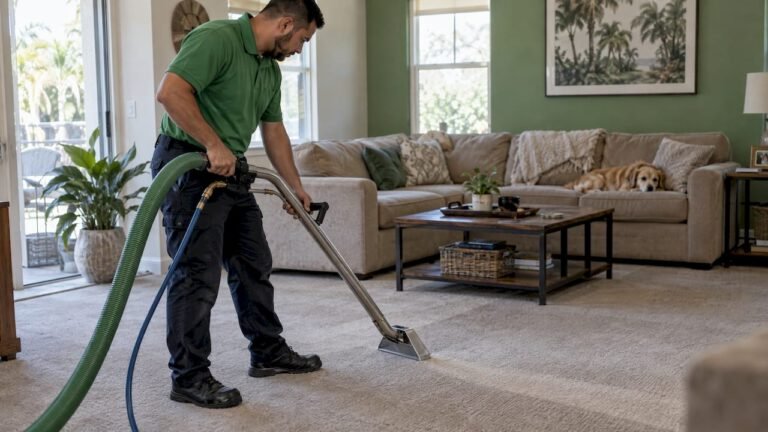
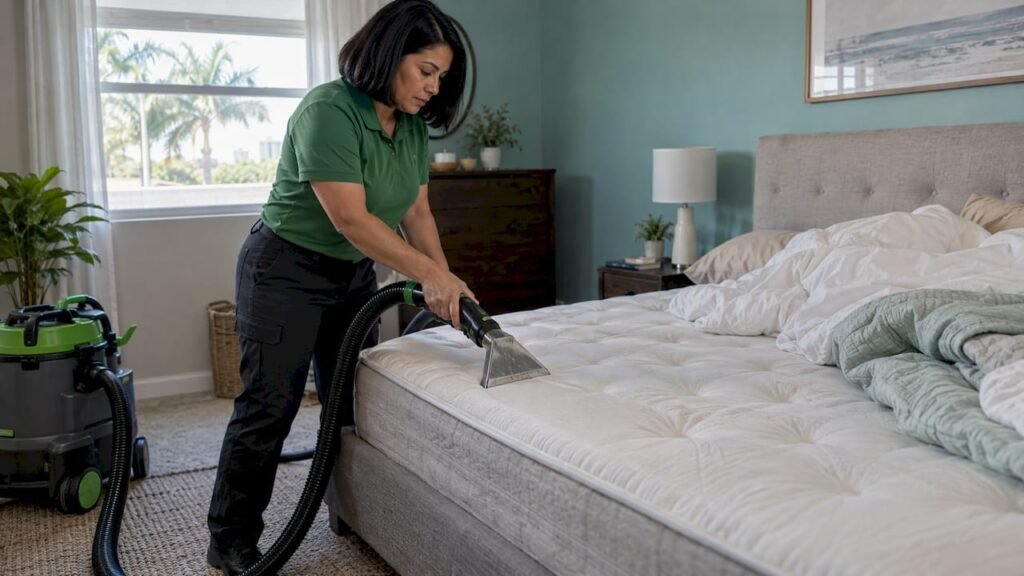
A mattress that smells will not stop smelling because you sprayed it. Odor comes from sweat, body oils, urine, pet accidents or trapped moisture sitting inside the layers, and surface products only reach the top of them. In humid South Florida, where moisture lingers, the lasting fix is a professional mattress cleaning that treats the source and not just the surface. Below you will find how to read the smell, what to do in the first hour, what to avoid, and when to stop treating it yourself.
TL;DR
- Mattress odor usually comes from organic residue (sweat, urine, pet accidents) or from trapped moisture, so the smell returns when only the surface is treated.
- After an accident, blot, do not rub, and do not soak the mattress. Foam and latex are very porous and slow to dry.
- Bleach and harsh cleaners can damage the mattress and be harmful to people and pets.
- If the smell comes back after the mattress dries, it has likely reached the inner layers, and that is the point to book a professional.
- A new mattress smell is off-gassing: air it out in a room you do not use much before sleeping on it.
Table of Contents
- Why mattresses hold on to odors
- Read the smell before you treat it
- The first hour after an accident
- What not to do to a smelly mattress
- When the smell keeps coming back
- What professional mattress cleaning gives you
- New mattress smell is a different problem
- Keeping odors from returning
- Our offer for mattress odor
- Our perspective
- FAQ
- Sources
Why mattresses hold on to odors
A mattress is a thick stack of fabric, foam and padding. Every night it absorbs sweat and body oils. Tom’s Guide notes that sweat, body oils, dust and dust-mite debris feed the bacteria that cause bad smells, which is why a bed can smell stale even without a visible stain.
Liquids go deeper. Urine, spilled drinks or a pet accident move past the cover and into the padding, where you cannot wipe them away. Moisture is the second problem. In Miami, Broward and Palm Beach counties, heat and humidity keep fabrics damp longer, and a mattress that stays damp develops a musty smell. Our work in South Florida homes is built around exactly this: carpets, upholstery and mattresses that trap moisture and the odors that come with it.
That is also why odor is persistent. A smell is not a stain on the surface. It is residue and moisture inside the layers, and it keeps giving off odor until it is actually removed.
Read the smell before you treat it
Different odors point to different causes, and the cause decides the right response.
| Smell | Likely cause | What it calls for |
|---|---|---|
| Stale, sweaty, “slept-in” | Sweat, body oils, dust and dust-mite debris built up over months | Regular cleaning and fresh, dry bedding |
| Sharp ammonia, worse on humid days | Urine (child, pet or adult) | Prompt, correct treatment of the organic residue; see our guide on mattress urine stain cleaning |
| Musty, damp, like a closet | Trapped moisture | Full drying and professional cleaning |
| Chemical, plastic-like, on a new bed | Off-gassing from manufacturing and packaging | Airing out, covered below |
| Smell that returns after cleaning | Contamination in inner layers | Professional cleaning, and in severe cases replacement |
Urine deserves special mention for South Florida homes. Odor-causing residue can reactivate when humidity rises, so a mattress that seemed fine in the dry season can smell again in a humid week. A smell that comes and goes with the weather is a sign the source is still in the mattress.
The first hour after an accident
What you do immediately matters, because the less liquid reaches the core, the better the outcome. Wirecutter’s accident routine starts with blotting with dry paper towels instead of scrubbing. Sleep Foundation gives the same instruction for urine: blot without rubbing. Rubbing pushes the liquid deeper into the padding.
A few safe habits for the moment itself:
- Strip the bedding and wash it separately.
- Press clean, dry towels onto the wet area until little moisture transfers.
- Keep the room ventilated and use a fan to move air across the surface.
- Keep people and pets off the mattress until it is dry.
- Book a cleaning. The sooner residue is dealt with, the less time it has to settle into the layers.
Martha Stewart’s expert guide points out that organic stains respond to upholstery-safe enzyme-based cleaners because enzymes break down the organic material behind the stain and smell. That is the logic professionals build on: remove the source, do not perfume it.
What not to do to a smelly mattress
Most of the damage we hear about comes from well-meant fixes.
Do not soak it. Tom’s Guide warns that memory foam and latex are extremely porous and should never get wet, because too much liquid makes the mattress hard to dry and can lead to mold. Sleep Foundation advises using as little solution as possible and notes that detergents are difficult to fully remove from a mattress.
Do not use bleach or harsh chemicals. Sleep Foundation cautions that bleach and harsh agents can be harmful to humans and pets and can damage the mattress. It also warns that hydrogen peroxide can damage foam or latex and discolor fabric. This matters most for families with young children and for pet owners, since the mattress is where they spend hours with their face close to the fabric.
Do not flip it while damp. Eclipse International CEO Stuart Carlitz, quoted by Wirecutter, warns that turning a damp mattress over on its frame leaves it damp and invites mildew.
Do not rely on a vinegar mist to sanitize. Vinegar can change how a surface smells, but a light mist is not a substitute for removing urine, vomit or blood from the inside of a mattress.
Do not cover it up. Air fresheners and scented sprays mask odor for a day. Residue that is still in the mattress will keep producing the smell.
When the smell keeps coming back
The clearest signal that surface care is not enough is a returning odor. Martha Stewart’s guide says that if the smell comes back after the mattress dries, urine may have reached the inner layers, and that some urine stains are best left to professionals. Experts quoted there add that homes with small children, elderly residents, odor-sensitive people or low airflow are the cases where this matters most.
Book a professional when you notice any of these:
- The smell returns after the mattress has fully dried.
- A pet or child has had repeated accidents on the same bed.
- The mattress smells musty, which points to moisture inside.
- A rental or guest-room mattress has an unknown history.
- Anyone sleeping on it has allergies or asthma and you want the bed truly refreshed.
For homes in the tri-county area, our page on why South Florida mattresses need professional cleaning explains how the local climate affects what builds up in a bed.
What professional mattress cleaning gives you
Professional cleaning is the first choice because it reaches what you cannot, and it takes the guesswork off your hands: which product suits the fabric, how much moisture is too much, and how to get the mattress properly dry.
Here is what you can expect from Dr. Steemer:
- IICRC-certified technicians. IICRC is the Institute of Inspection, Cleaning and Restoration Certification, the standards body for the cleaning and restoration trade.
- Advanced extraction methods. Our approach is designed to remove allergens, odors and dirt without damaging fabrics.
- Eco-friendly, pet-safe cleaning. This is the right fit for families and for homes where pets sleep on the bed.
- Fast booking. Same-day and next-day appointments are available, which matters when the accident just happened and you want it handled before the smell sets.
- A 21-day satisfaction guarantee.
We serve Miami-Dade, Broward and Palm Beach counties. If you want local details, see our pages for Miami-Dade, Broward County and Palm Beach County. If the same pet is also leaving smells in your carpet, our guide to pet urine carpet cleaning covers that side, and the bedroom rug, drapes and upholstery can be cleaned in the same visit window.
New mattress smell is a different problem
A chemical smell from a brand-new mattress is off-gassing: volatile organic compounds (VOCs) released from manufacturing and packaging. It is not dirt, and cleaning will not solve it. Time and airflow do.
American Lung Association environmental health director Kevin Stewart told Reviewed that most healthy adults will not experience side effects from mattress VOCs, but a new mattress should air out in a room you do not spend much time in for at least a day, and ideally one to two weeks. People with asthma or chronic lung disease, and babies and children, are more sensitive. If anyone in your household is in those groups, plan the airing period before the mattress goes into a bedroom, and ask the person’s doctor if you have questions about symptoms.
The same source reports that a Consumer Product Safety Commission spokesperson said heat helps compounds air out faster, and that mattresses shipped compressed in a box trap VOCs in the plastic wrapping until it is opened. So unwrap it early and let it breathe.
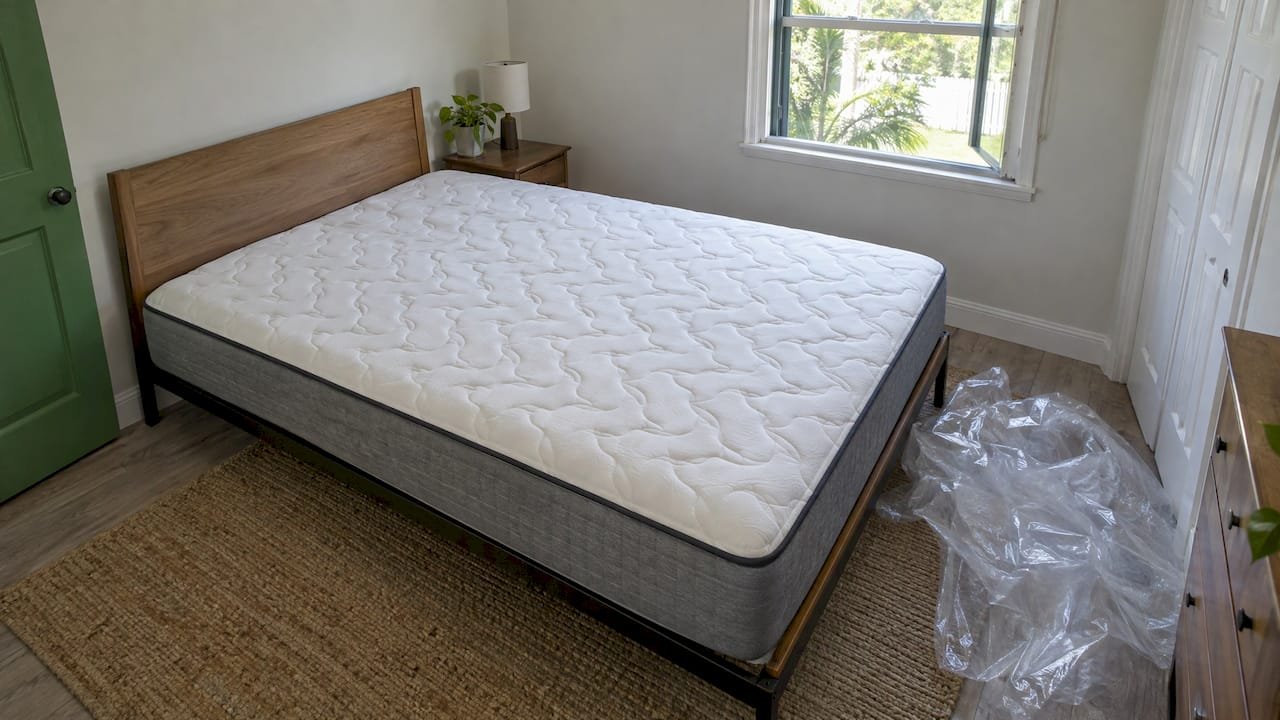
Once the new smell fades, an old odor that appears later is a cleaning question, not an off-gassing one.
Keeping odors from returning
A cleaned mattress stays fresh longer with a few habits:
- Use a breathable protector. A protector catches sweat and accidents before they reach the padding.
- Wash bedding often. Sleep Foundation’s mattress guide lists vacuuming with an upholstery attachment as a regular step, which keeps debris from building up.
- Let air in. Open the bedroom now and then, and keep the mattress off damp floors.
- Dry everything fully. Moisture is what turns a small spill into a musty bed, especially in a humid climate.
- Schedule periodic cleaning. Property managers with rental units and families with pets or young children benefit most from a routine, because the next guest or tenant starts from a fresh bed.
Our offer for mattress odor
If your mattress smells of urine, sweat or damp, we can clean it at your home in Miami-Dade, Broward or Palm Beach County. Our IICRC-certified team uses eco-friendly, pet-safe cleaning, backs the work with a 21-day satisfaction guarantee, and offers same-day and next-day booking. See the details and book on our mattress cleaning page.

Mattress cleaning has no published price, so request a quote for your mattress size and condition.
Our perspective
Most people try to solve a mattress smell with whatever is in the pantry, and then wonder why it comes back in the next humid week. The reason is simple: the smell is not on the surface. It is in the layers.
In South Florida the problem is amplified. Heat and humidity keep moisture in fabrics, and moisture keeps odors alive. That is why we design our cleaning around the local climate, not around a generic routine.
Our technicians are IICRC-certified, our products are eco-friendly and pet-safe, and our extraction methods are designed to remove allergens, odors and dirt without damaging fabrics. For families, that means a bed that is safe to sleep in. For property managers, it means turnover-ready mattresses. And because we offer same-day service and a 21-day satisfaction guarantee, you do not have to live with the smell while you wait.
If there is a smell in your bedroom, treat the source, and let us handle it.
Dr
FAQ
How do you get smells out of a mattress?
The smell is coming from residue and moisture inside the mattress, so the fix has to reach that residue. For light, stale odor, regular vacuuming and fresh bedding help. For urine, pet accidents or a musty smell, a professional cleaning is the dependable route. Dr. Steemer provides mattress cleaning across Miami-Dade, Broward and Palm Beach counties.
Can you sleep on a mattress while it is off-gassing?
Most healthy adults are not expected to have side effects from mattress VOCs, according to the American Lung Association’s Kevin Stewart in Reviewed. Still, he recommends airing a new mattress in a room you rarely use for at least a day, and ideally one to two weeks. If anyone has asthma or chronic lung disease, or the sleeper is a baby or child, take the airing period seriously.
What does spraying vinegar on a mattress do?
Wirecutter explains that vinegar is an acid that reacts with the basic components in urine to neutralize the smell. It works only on the surface, so it is not a complete answer for urine that has soaked in. Keep any liquid light, since too much moisture is hard to dry out of a mattress.
How do you clean a badly stained mattress?
Blot first, never rub, and keep liquid to a minimum. Heavy or old stains, and any stain with an odor that returns, are best handled by a professional. If you are in South Florida, you can book mattress cleaning with same-day or next-day options.
Is the mattress too far gone to clean?
If a smell persists or returns after a proper cleaning and full drying, ask a professional to look at it. Experts quoted by Martha Stewart note that in some cases, especially with severe urine contamination, replacement may be the right call.
Sources
- Tom’s Guide: how to get smells out of a mattress
- Tom’s Guide: how to get stains out of a mattress
- Sleep Foundation: how to clean a mattress
- Sleep Foundation: urine smell and stains in a mattress
- Wirecutter: how to clean your mattress
- Martha Stewart: how to remove mattress stains
- Reviewed: mattress off-gassing
Recommended
- Mattress Urine Stain Cleaning: What Works and When to Call a Pro
- Carpet Odor Removal: Find the Source, Fix It for Good
- Mildew Smell in Carpet: Causes, Fixes and When to Call a Pro
- Professional Mattress Cleaning in Broward and Miami-Dade Counties: Why It Matters
Want it done right the first time?
Our IICRC-certified team handles carpet, upholstery, tile and stone across Miami-Dade, Broward and Palm Beach, usually the same day.