Porcelain tile is one of the toughest floors in a home, so the tile itself rarely gives you trouble. The grout between the tiles does. It soaks up grease, soap film and humidity, and the wrong cleaner can make it worse. Routine care is simple, and this guide covers it. When grout has turned dark or a film won’t come off, professional cleaning gets the floor back to its original look without risking the surface. In South Florida, our IICRC-certified team at Dr. Steemer does that work in Miami, Broward and Palm Beach counties, with same-day and next-day booking and a 21-day satisfaction guarantee.
TL;DR
- Porcelain is dense and stain-resistant. Most problems come from grout, from cleaner residue, or from the wrong product.
- For routine cleaning, sweep first, then mop with a pH-neutral tile cleaner or mild soap and warm water. Rinse and dry so no film is left.
- Avoid ammonia, bleach, acids (including vinegar for regular use), wax, oil soaps and steel wool.
- Dark, stained or sticky grout that survives your cleaning is the signal to call a professional, not to scrub harder.
- In humid South Florida, mold in grout lines is common, and a deep clean with hot water extraction restores the floor.
Table of Contents
- Why porcelain is easy to clean, and grout is not
- Glazed or unglazed: check before you choose a cleaner
- How to clean porcelain tile: the routine
- What not to use on porcelain tile
- How often to clean porcelain tile
- Ingrained dirt, dark grout and stains
- When professional tile cleaning is worth it
- Where our process fits at each step
- Book professional porcelain tile cleaning
- Our perspective
- FAQ
- Sources
Why porcelain is easy to clean, and grout is not
Porcelain is made from fine clay fired at high heat. The result is a hard, low-porosity surface. A manufacturer’s care guide notes that porcelain resists strongly acidic and alkaline products, with the exception of hydrofluoric acid, which is rarely found in household products. So the tile surface forgives a lot.
Grout is different. The Tile Council of North America explains that grout is mostly cement and sand. Sand is unaffected by most cleaners, but cement is alkaline and is dissolved by acids. That is why a product that is harmless to the tile can slowly eat away the joints around it.
Grout is also porous. Spilled grease, mop water and humid air all get into it. In Miami, Fort Lauderdale and West Palm Beach, where indoor humidity stays high for much of the year, grout lines are where dirt and mildew show up first, even on a floor that looks fine from standing height.
Glazed or unglazed: check before you choose a cleaner
Most porcelain floors sold for homes are glazed, which means a thin protective coating sits on top. Polished porcelain is the glossiest version and shows streaks and water spots the most. Unglazed (often called through-body) porcelain has a matte, sometimes textured finish.
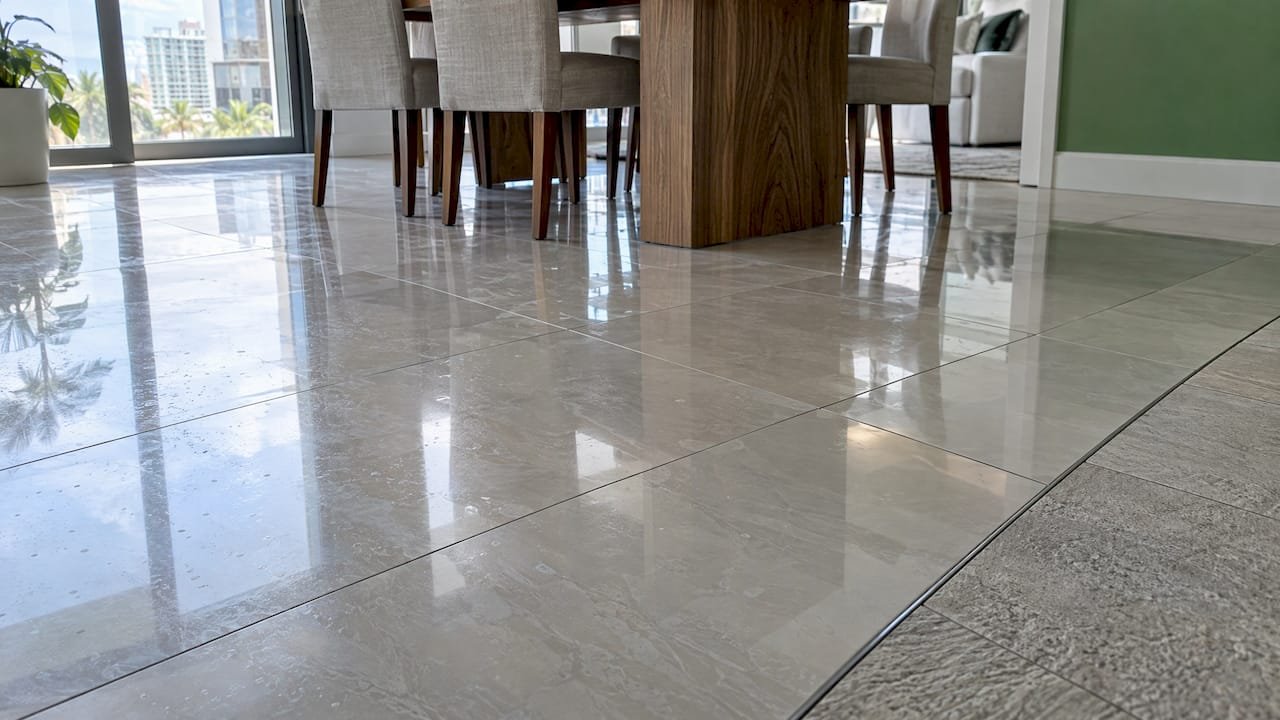
The distinction matters because the care instructions differ. American Olean’s guidance says warm water and mild soap is enough for regular cleaning of glazed tile, while unglazed tile calls for a concentrated neutral-pH tile cleaner. Textured tiles also hold more dirt: Mapei notes that heavily textured tiles need more frequent and more intense cleaning than smooth ones.
If you don’t know what you have, look for the leftover tile box, the installer’s paperwork, or ask us when we assess the floor.
How to clean porcelain tile: the routine
The steps below follow the care guidance of tile manufacturers.
Step 1: Remove loose grit
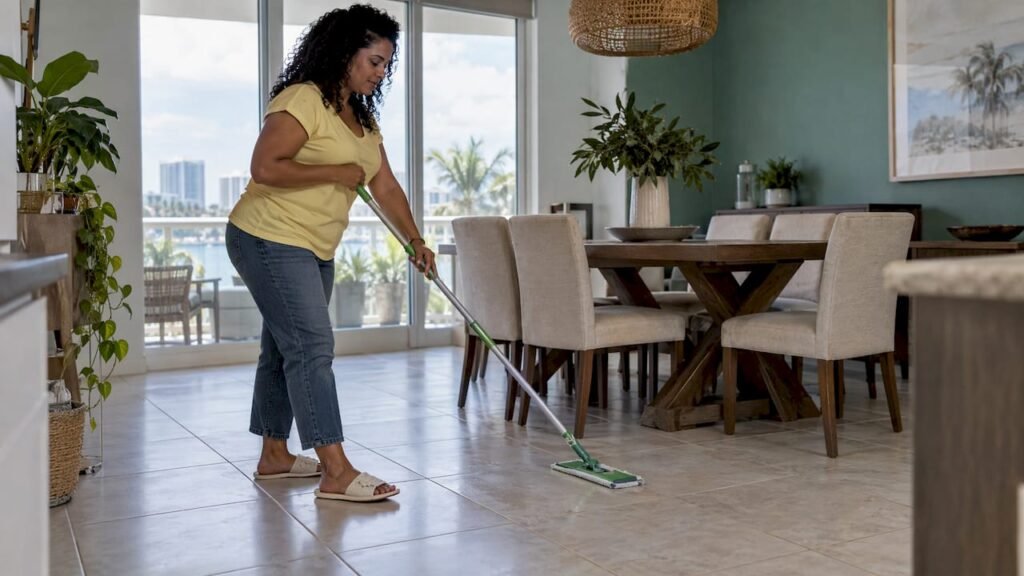
Sweep or vacuum before you mop. Use a soft-bristle broom, or a vacuum with the beater bar off. Fine particles can scratch porcelain over time, and mopping over grit just grinds it in. On textured tile, sweep in more than one direction so dirt comes out of the surface pattern.
Step 2: Mop with the right solution
Use warm water with a little mild soap, or a pH-neutral cleaner made for tile and grout, mixed at the label’s dilution. Daltile’s maintenance guide recommends a low-VOC, nonhazardous cleaner at the manufacturer’s dilution and a microfiber mop head. On heavily soiled areas, let the solution sit 3 to 5 minutes before you mop.
More cleaner is not better. A stronger mix leaves residue, and residue is what makes floors look dull and sticky.
Step 3: Rinse and dry
This is the step most people skip. The Tile Council notes that even a good alkaline cleaner leaves a sticky soap film if it isn’t rinsed properly. Rinse with clean water, pick up the excess, and dry with a clean cloth or microfiber. NFM’s care guide says drying also increases shine and prevents water spots.
One more tip from flooring expert Leah Howell: a bucket mop can push dirty water into grout lines and leave residue there. Change the water often, and wring the mop well.
Step 4: Keep dirt from arriving
Place doormats inside and outside every entrance, take shoes off at the door, and sweep up visible debris promptly. Mats at the entrances do more for a tile floor than any cleaner.
What not to use on porcelain tile
This is the most common search question, and the answer mostly concerns grout and the tile’s finish.
| Avoid | Why |
|---|---|
| Ammonia, bleach and acid-based cleaners | NFM’s guide says they can change grout color and stability. |
| Vinegar for routine mopping | Mapei says even diluted vinegar can damage cement-based grout. |
| Oil soaps and wax-based cleaners | Grout absorbs them and keeps a film that attracts more dirt. Wax also makes tile slippery. |
| All-purpose cleaners, degreasers and dyed cleaners | Mapei advises using only pH-neutral cleaners made for tile and grout. |
| Steel wool and abrasive pads | They can scratch the tile and leave rust stains in grout. |
| Dust mops treated with sprays or oils | They leave an oily layer on the surface. |
The National Tile Contractors Association’s technical trainer, Robb Roderick, puts it plainly: for most tile, including porcelain, warm water and dish soap are all you need, because strong vinegar solutions weaken grout and etch stone.
If your home also has natural stone such as marble or travertine, acids are even more of a problem on those surfaces. See our guide to terrazzo floor care for what that floor needs.
How often to clean porcelain tile
Frequency follows foot traffic. A routine Martha Stewart’s expert guide lays out:
- Daily: a quick sweep or dry mop with a soft microfiber mop.
- Weekly: a thorough clean with a pH-neutral hard-surface cleaner.
- Every 1 to 4 months, depending on traffic: a tile-safe floor polish, per the same guide.
Busy kitchens and main bathrooms may need weekly cleaning, while little-used rooms can go a few weeks. Showers are a separate case: wipe wet tile daily with a squeegee, because standing moisture is what grows mildew.
For commercial spaces, such as lobbies, restaurants and retail floors, the traffic is much higher. Daltile’s guidance for large areas and periodic heavy cleaning describes a cylindrical autoscrub machine with a soft-to-medium brush and a 5 to 10 minute dwell time. Property managers who schedule that kind of periodic deep cleaning keep floors presentable and keep grout from darkening between visits.
Ingrained dirt, dark grout and stains
When the regular routine stops working, the cause is usually one of four things.
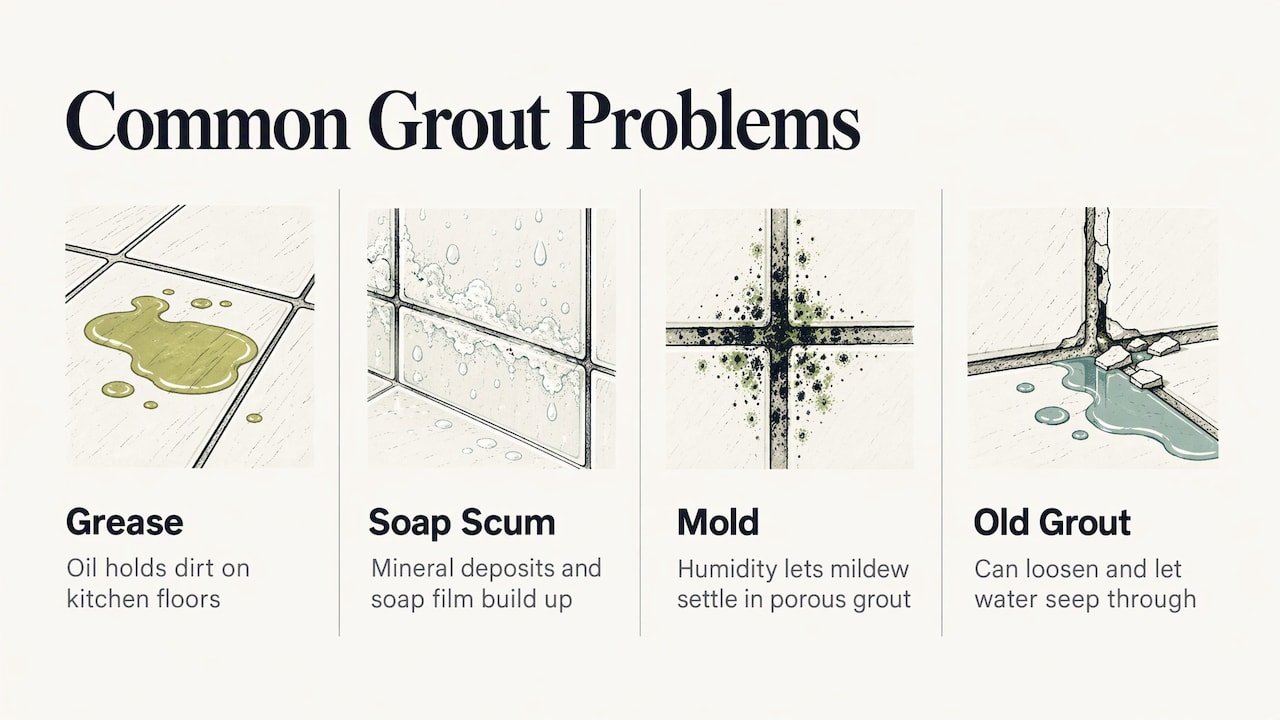
Grease and cooking film. Kitchen floors collect a thin layer of oil that holds dirt. A heavy-duty alkaline cleaner is the correct chemistry here. One manufacturer’s data sheet for a tile-and-grout alkaline cleaner calls for a 1 to 5 dilution, vigorous agitation and a 5 to 15 minute dwell, then a thorough rinse. It also warns that this kind of product is not for polished marble, limestone, terrazzo or travertine, which is exactly why the product has to match the floor.
Soap scum and hard water. In bathrooms, mineral deposits and soap film build up on tile and in the grout. These often need a dedicated cleaner and careful rinsing.
Mold and mildew. Humidity lets mildew settle into porous grout. A light surface film can be wiped, but black growth that keeps returning means moisture is getting into the joint. If it follows a leak or flooding, it needs proper remediation. How HEPA filtration makes mold cleanup safe explains why containment matters when mold is disturbed.
Old, neglected grout. Therapy Clean founder Anne Ruozzi says widespread discoloration of tile and grout warrants a professional assessment, because neglected grout can loosen and let water seep through, creating hidden mold.
That last point is the one to take seriously. Scrubbing harder with a stiff brush, or trying stronger chemicals, is how homeowners end up with scratched tile, etched grout and a floor that needs regrouting. Stains that don’t respond to a gentle cleaner are the cue to stop and have the floor assessed.
When professional tile cleaning is worth it
Porcelain floors are an investment, and the grout is the part that ages. Professional cleaning makes sense when:
- grout has stayed dark or stained after proper mopping and rinsing;
- the floor has years of built-up residue, or a haze after construction or renovation;
- you see greasy, sticky traffic lanes in a kitchen, restaurant or entryway;
- mildew keeps coming back in a shower or on a bathroom floor;
- you have pets and want odors and stains lifted from grout lines without harsh chemicals;
- you manage a property and want consistent results across many rooms or units.
We cover the signs in more detail in our guide to warning signs your tile and grout needs professional cleaning, and what a visit involves in what pros do, cost and when to hire.
Where our process fits at each step
The routine above works for light upkeep. A deep clean differs at three points.
Matching the method to the floor. Our technicians are IICRC-certified and use hot water extraction, which cleans and lifts the dirty water out of the grout instead of leaving it to dry in the joints. That addresses the problem the Tile Council describes: the best method is to apply cleaner and vacuum up the dirty water, then rinse and vacuum again.
Safe products. We use eco-friendly, pet-safe cleaning solutions, which suits families and pet owners who don’t want harsh residue on a floor where children and animals spend time.
Fast scheduling. Same-day and next-day booking is available, which helps before guests arrive, after a spill, or when a commercial space needs to reopen.
You can see how this looks in practice in our before and after tile and grout results, and read how professional tile cleaning protects Fort Lauderdale floors from long-term damage.
Book professional porcelain tile cleaning
If your grout has gone dark or your floor has lost its finish, our team can clean porcelain tile and grout at your home or business in Miami-Dade, Broward and Palm Beach counties. Every job is backed by our 21-day satisfaction guarantee, and same-day and next-day appointments are available. Start with our tile and grout cleaning service or see the Miami tile and grout restoration page.

We also clean carpets, area rugs, upholstery, air ducts and drapery, so one visit can cover several surfaces. See everything on our main site.
Our perspective
Porcelain gives people a false sense of security. The tile is hard, so they assume anything goes. Then the grout turns gray, the floor feels tacky, and the cause is nearly always the same: a cleaner that was too strong, too much of it, or not rinsed.
In South Florida, humidity makes it worse. Grout stays damp longer, mildew finds it, and routine mopping spreads dirty water through the joints. That is why we treat tile and grout as one system and clean them together, with hot water extraction that pulls the soil out instead of moving it around.
Our advice is simple. Keep up the daily sweep, use a pH-neutral cleaner, and rinse. When the grout stops responding, call us before you reach for bleach or a wire brush. A floor that has been cleaned correctly the first time lasts years longer than one that has been through a series of experiments.
Dr
FAQ
What do you use to clean porcelain tile?
Warm water with a little mild soap, or a pH-neutral tile cleaner mixed to the label, applied with a microfiber mop. Rinse with clean water and dry the floor. Skip ammonia, bleach, acids and oil-based cleaners.
Is it worth having porcelain tile professionally cleaned?
Yes, when grout is dark, residue has built up over years, or mildew keeps returning. Professional cleaning removes soil from the grout lines without the scratching and etching that aggressive DIY methods can cause. Our tile and grout cleaning is backed by a 21-day satisfaction guarantee.
Can I use vinegar on porcelain tile?
It is better not to. The tile itself tolerates it, but vinegar is acidic, and even diluted vinegar can damage cement-based grout. A pH-neutral cleaner or mild dish soap is the safer routine choice.
How do I get ingrained dirt out of porcelain tile?
Ingrained dirt usually sits in the grout or under a layer of old cleaner residue. A cleaner suited to the soil type, enough dwell time and a thorough rinse are what remove it. If the floor still looks dull, our team can deep clean it.
Do you clean porcelain tile in homes and businesses?
Yes. We serve homeowners, landlords, property managers and businesses in Miami-Dade, Broward and Palm Beach counties, and offer same-day and next-day booking.
Sources
- Daltile: Ceramic and porcelain tile care and maintenance
- Garden State Tile: Porcelain Tile Care and Maintenance (2025)
- American Olean: Porcelain tile care instructions
- Mapei: How to clean, maintain and care for ceramic and porcelain tile
- NFM: Cleaning glazed porcelain and ceramic
- Tile Council of North America: Cleaning grout
- NCL: CYCLONE product page
- Martha Stewart: How to clean porcelain tile safely and effectively
- Martha Stewart: How to clean tile and grout
- How HEPA filtration makes mold cleanup safe
Recommended
- Tile and Grout Cleaning Broward and Miami-Dade | Before & After Results
- Grout Cleaning Service: What Pros Do, Cost and When to Hire
- Warning Signs Your Miami Beach Tile and Grout Needs Professional Cleaning
Want it done right the first time?
Our IICRC-certified team handles carpet, upholstery, tile and stone across Miami-Dade, Broward and Palm Beach, usually the same day.