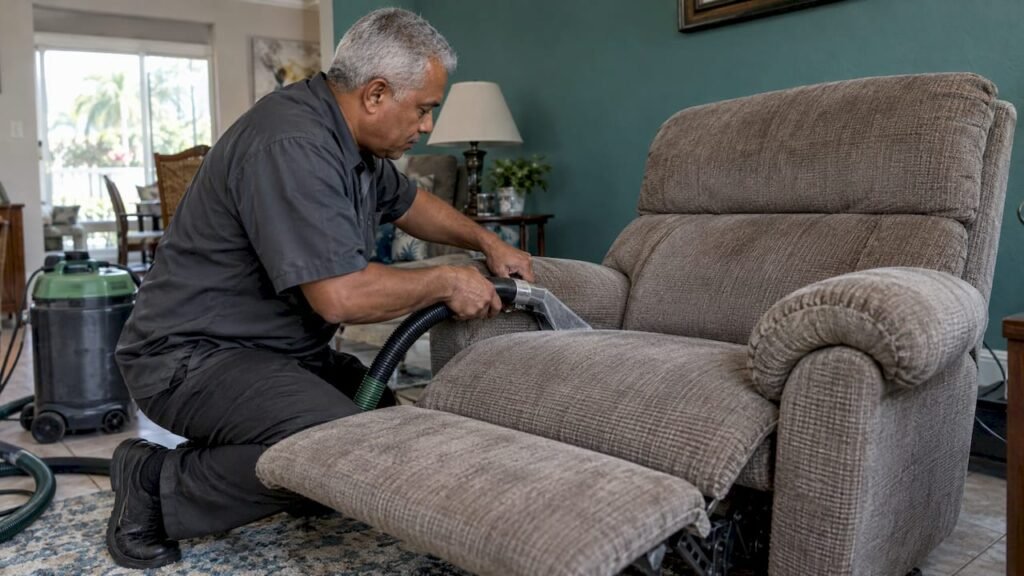
A recliner takes more wear than almost any other chair in your home. It holds body oils, sweat, spilled drinks, pet dander and the dust that settles into every seam of the mechanism. The best way to get one properly clean is to have an IICRC-certified upholstery team match the method to the fabric. That is the work we do at Dr. Steemer for homes and businesses in Miami-Dade, Broward and Palm Beach counties, with same-day service available and a 21-day satisfaction guarantee.
This guide covers what decides how a recliner or loveseat should be cleaned, what a professional visit involves, and how to keep the chair fresh afterward.
TL;DR
- The fabric decides the method. The cleaning code on the tag (W, S, W-S or X) tells you what the maker allows, and X-coded fabric is for vacuuming or professional care only.
- Heavily soiled recliners, S-coded fabrics, leather and pet accidents are the cases where professional cleaning is the safe route.
- Urine can soak past the fabric into the cushion fill, so pet odors need more than surface cleaning.
- Loveseats and chairs in the same room can be cleaned in one visit, so the whole set looks uniform.
- Regular vacuuming and a fabric protector make each professional cleaning more effective.
Table of Contents
- Why a recliner is harder to clean than it looks
- Read the cleaning code first
- Which fabrics suit which professional method
- Pet stains and odors in a recliner
- What a professional recliner cleaning visit looks like
- Getting your recliner ready for the visit
- Loveseats and the rest of the room
- What a recliner cleaning costs
- Keeping the chair fresh between visits
- Our perspective
- Book recliner and loveseat cleaning in South Florida
- FAQ
- Sources
Why a recliner is harder to clean than it looks
A recliner is not a flat sofa cushion. It has a footrest, a moving back, deep creases where the seat meets the arms, and often a headrest that touches skin and hair every day. Dust and body oils collect in those folds, and a quick wipe on top never reaches them.
The fabric adds the next layer of difficulty. Recliners come in microfiber, polyester blends, chenille, velvet, linen-look weaves, bonded leather and genuine leather. Each reacts differently to water, heat and cleaning agents. A method that lifts soil from a polyester microfiber can leave rings on a velvet or turn a cotton-linen blend yellow-brown as it dries.
That is why most furniture makers steer owners away from deep cleaning a badly soiled piece at home. Wirecutter reports that almost all the furniture manufacturers it spoke with don’t recommend deep-cleaning a heavily soiled couch yourself. The same logic applies to a recliner, which has more crevices and a more complicated frame.
Read the cleaning code first
Since 1969, upholstered furniture has carried a cleaning code on its tag, usually under a seat cushion or on the underside of the frame. The Spruce explains the codes like this:
| Code | What it means |
|---|---|
| W | Water-based cleaners are fine |
| S | Dry-cleaning (water-free) solvent only, in a well-ventilated room with no open flames |
| W-S | Either water-based or solvent cleaners |
| X | Vacuum or professional cleaning only; home products can cause staining and shrinking |
Manufacturers say the same thing in their own care sheets. Frontgate’s care codes state that S-coded fabric must be cleaned by a professional furniture cleaning service with a solvent-based agent and no water, and that X-coded fabric should only be vacuumed or lightly brushed with a non-metallic brush. Bernhardt’s instructions direct owners to an IICRC-certified firm that specializes in upholstery when the whole piece is soiled, and to clean seam to seam rather than just the spots.
Two safety notes belong here. Solvent cleaners need a well-ventilated room away from open flames. And Hickory Chair’s care guide warns that products containing carbon tetrachloride are highly toxic and should be avoided on S- and SW-coded fabrics. If you cannot find a tag, or the code is S or X, that is the moment to book a technician instead of experimenting.
Which fabrics suit which professional method
A professional does not use one process for every chair. The method is chosen for the fabric, and the main options work like this.
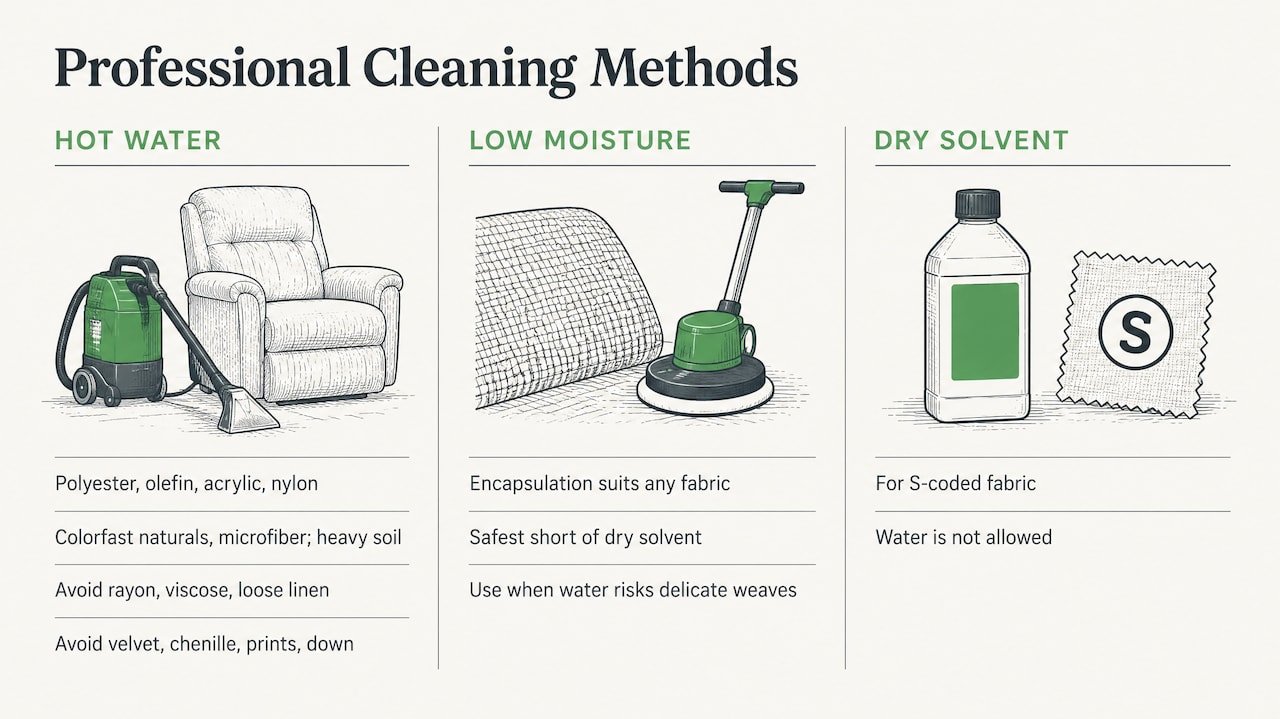
Hot water extraction. Hot water and cleaning solution are applied, then pulled out with strong suction. According to The Cleaning Standard, it suits synthetic fibers such as polyester, olefin, acrylic and nylon, colorfast natural fibers, microfiber, and moderate to heavy soil. It is the same extraction approach we use on carpets, and our technicians are IICRC-certified.
Low-moisture and encapsulation cleaning. The same source describes encapsulation as the safest method short of dry solvent cleaning for any fabric. Low-moisture methods are the choice where water is a risk, such as delicate weaves.
Dry solvent cleaning. This is the route for S-coded fabric, where water is not allowed at all.
The same resource lists fabrics where hot water extraction should be avoided: rayon or viscose, loose-weave linen, cotton or linen that may brown, velvet or chenille, printed fabrics and down cushions. For those, the technician picks a gentler process. This is the heart of the decision: the right answer for your recliner depends on what it is made of, and a trained eye reads that faster and more reliably than a label alone.
Leather recliners
Leather has its own rules. Hickory Chair’s guidance is that leather should never be cleaned with saddle soap, oils, detergents, furniture polish, abrasive solvents or ammonia. Keep leather out of direct sun and away from heat, as Frontgate advises. Leather care is a job for someone who has cleaned it before, not a household product from under the sink.
Down-filled cushions and browning
Two hidden problems are worth knowing about. The IICRC warns that flame retardant on the inner ticking of many modern down- or feather-filled pieces can cause serious staining or color change when exposed to moisture, including during professional cleaning. The FTC has recently banned applying these retardants in the US, so it mostly affects older or imported pieces. The IICRC also describes cellulosic browning: linen or cotton that gets wet and dries slowly can turn yellow to brown. Its advice is not to fix browning yourself but to contact an IICRC-certified technician.
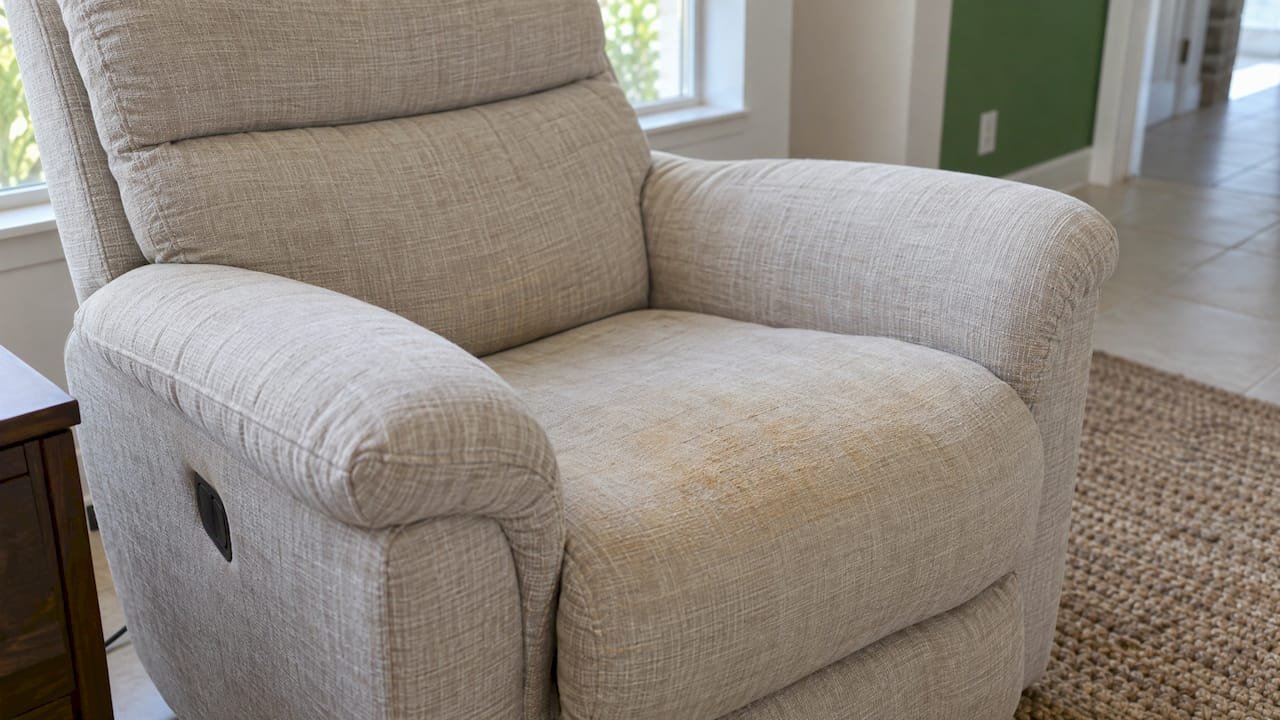
If your recliner has loose down-filled cushions, or a natural-fiber cover, tell the technician when you book so the plan is made before anything gets wet.
Pet stains and odors in a recliner
Pet owners know the problem: you clean the surface, and the smell returns on a warm day. There is a reason. The IICRC explains that urine can penetrate beneath the upholstery fabric into the cushion fill and structural materials. A certified technician may inject an odor treatment into those layers, but nobody can see whether it reached every deposit.
That is useful to know when you plan the job:
- Treat an accident as soon as you find it, and tell the technician where it happened and roughly how long ago.
- Point out every spot where the pet sleeps or sits, not only the visible stains.
- For very old or repeated accidents, ask about cushion treatment as well as surface cleaning.
Our cleaning solutions are eco-friendly and pet-safe, which matters in homes where dogs and cats lie on the furniture within hours of a visit. We explain the same issue for beds in our guide to mattress urine stain cleaning.
What a professional recliner cleaning visit looks like
Wirecutter describes the standard professional process: a fabric inspection, product testing on a hidden spot, removal of dry soil, then chemical products, heat, agitation and time to separate the soil, which is then extracted by absorption, wet vacuuming or rinsing. In practice you can expect these stages:
- Inspection and fabric ID. The technician checks the tag, the fabric and the condition of the chair: stains, pet damage, worn spots.
- Dry soil removal. Crumbs, hair and dust come out first, including from the seams and under the cushions.
- Pre-treatment of stains. Stains are treated with a product suited to the fabric and the type of stain.
- Cleaning and extraction. The chosen method, hot water extraction, low-moisture or solvent, loosens and removes the soil.
- Final check and drying guidance. The chair is checked and you are told how to let it dry.
For a deeper look at how this works on chairs specifically, see our guide to chair upholstery cleaning codes, steps and when to call a pro. For a wider view that includes sofas and sectionals, read furniture deep cleaning methods and steps.
Getting your recliner ready for the visit
A little preparation makes the visit smoother:
- Remove throws, pillows, remote holders and anything in the side pockets.
- Locate the tag and note the code if you can find it.
- Give the chair a quick vacuum across the surface, Good Housekeeping’s advice is to cover the whole piece, including under removable cushions and along the seams.
- Make a list of stains, with what caused them and when, if you know.
- Clear a path to the chair and move small items from the surrounding floor.
Do not attempt to treat a stain with an all-purpose cleaner beforehand. Leave it for the technician, who can choose a product that suits the fabric. Rubbing hard or over-wetting can push a stain deeper or leave a ring.
Drying time depends on the fabric, the method and the humidity in the room. Keep the air moving with a fan or the air conditioning, and keep pets off the chair until it is fully dry.
Loveseats and the rest of the room
A loveseat is cleaned the same way as a recliner, with the same fabric rules, though it has fewer moving parts and more flat seat area. If you have a matching sofa, recliner and loveseat, having them cleaned together keeps the color and freshness even. Mismatched shades are common when only one piece in a set is cleaned.
It also helps to think about the soft surfaces around the chair. Carpets and area rugs hold dust that ends up back on the furniture, and curtains and blinds hold it at window height. If you are also thinking about window coverings, cleaning vertical blinds properly follows its own rules. We clean carpets, area rugs, drapery and mattresses too, so one visit can cover several pieces.
For a look at the results on a real piece, see our sofa upholstery cleaning before-and-after from South Florida. Property managers with waiting-room chairs, office seating or hotel furniture can read about commercial upholstery cleaning schedules and pricing.
What a recliner cleaning costs
The price depends on the size of the chair, the fabric, how soiled it is, and whether there are pet stains or odors to treat. We do not publish a fixed upholstery price, because a small, lightly used loveseat and a large leather recliner with pet damage are different jobs. Tell us the number of pieces, the fabric and the problem, and we will quote the work before it begins.
For reference, here are our published prices for other services, in case you are bundling work: carpet cleaning is $99-$300, area rug cleaning is $1.50-$5.00 per square foot, and air duct cleaning is $250-$500. Drapery cleaning is $10-$50 per pleat.
Keeping the chair fresh between visits
A few habits stretch the time between professional cleanings:
- Vacuum weekly. Use the upholstery attachment on the seat, the arms, the headrest and the seams.
- Freshen with baking soda. Good Housekeeping recommends sprinkling it over the cushions, leaving it for 15 to 30 minutes, then vacuuming thoroughly. A light mist of fabric spray can neutralize lingering odors, as long as you do not over-wet the fabric.
- Blot spills right away. Press with a clean white cloth rather than rubbing. Frontgate advises avoiding colored cloths, aggressive rubbing and previously used rags.
- Consider a fabric protector. The IICRC says protectors do not make liquids bead up for good. They make vacuuming more effective and give you extra time to blot a spill before it absorbs, and they improve the results of scheduled and spot cleanings because soil has not gone as deep.
- Keep the chair out of direct sun and away from heat. This also protects the fabric color.
Our perspective
A recliner is the chair people use most, and the one they clean least. Over time the body oils, dust and pet dander settle into the seams and the fill, and a surface wipe cannot reach them.
We think the reliable approach is to identify the fabric first and then choose the method. Our team is IICRC-certified, we use hot water extraction where the fabric suits it, and our cleaning products are eco-friendly and pet-safe, so a family can use the room again without worrying about what was left behind.
South Florida adds its own challenge. Heat and humidity make soft furnishings hold moisture, and our processes are designed for that climate. We offer same-day and next-day booking, and we stand behind the work with a 21-day satisfaction guarantee.
Dr
Book recliner and loveseat cleaning in South Florida
If your recliner or loveseat has pet odors, set-in stains or years of body oils, our upholstery cleaning service is built for exactly that. Our IICRC-certified technicians serve Miami-Dade, Broward and Palm Beach counties, with same-day service available for urgent jobs and a 21-day satisfaction guarantee behind the work.
See the upholstery cleaning service and request your quote. Prefer a local page? We also serve Miami, Miami Beach, Fort Lauderdale and Delray Beach.
FAQ
How often should a recliner be professionally cleaned?
Many households schedule it about once a year, and sooner when the chair has pet accidents, heavy daily use or a visible spill that did not respond to gentle cleaning. Weekly vacuuming and a fabric protector make each professional visit more effective. Homes with allergies or pets often choose a shorter interval.
Can you steam clean a recliner?
It depends on the fabric. Hot water extraction suits synthetic fibers, microfiber and colorfast natural fibers, but it is not right for velvet, rayon, loose-weave linen or down cushions, and leather needs a different approach. A certified technician checks the tag and fabric first, then chooses the method.
Can pet urine odor be removed from a recliner?
Often it can, but it takes more than surface cleaning. According to the IICRC, urine can soak into the cushion fill beneath the fabric, so the technician may treat those layers as well. Tell us where the accident happened and how long ago so the right treatment is planned.
Is professional cleaning safe for kids and pets?
Our cleaning solutions are eco-friendly and pet-safe. Keep children and pets off the chair until it is completely dry, and keep the room ventilated, particularly if a solvent method was used on an S-coded fabric.
Can you clean a loveseat and a recliner in the same visit?
Yes. Having the whole set cleaned together keeps the fabric looking even, and you can add carpets, rugs or mattresses to the same appointment. Let us know all the pieces when you book.
Sources
- The Right Way to Clean a Couch, Per Experts (Good Housekeeping)
- How to Clean a Sofa (Wirecutter)
- How to Clean Upholstered Chairs (The Spruce)
- Upholstery Cleaning and Care Codes (Frontgate)
- Cleaning Instructions (Bernhardt)
- Fabric: Cleaning Codes and Care (Hickory Chair)
- Manual Upholstery Cleaning (The Cleaning Standard)
- IICRC Consumer Floor and Furnishings Care Information: Upholstery
- Cleaning vertical blinds (Drapery Company)
Recommended
- Furniture Deep Cleaning: Methods, Steps and When to Hire a Pro
- Couch Cleaning Miami | Expert Upholstery & Sofa Cleaning
- Chair Upholstery Cleaning: Codes, Steps and When to Call a Pro
- Upholstery Cleaning in Delray Beach: Methods, Costs, Care
Want it done right the first time?
Our IICRC-certified team handles carpet, upholstery, tile and stone across Miami-Dade, Broward and Palm Beach, usually the same day.