Blackout curtains are the hardest curtains to clean because the part that blocks the light, the coating or bonded layer on the back, is also the part that water, heat and strong cleaners damage. The safest route is professional drapery cleaning, where the fabric is handled by technicians who work with lined and coated panels. Between cleanings, a light vacuuming keeps dust under control. If you have sheers hanging next to your blackout panels, they need a different, gentler routine, covered below.
We clean drapery for homes and businesses in Miami, Broward and Palm Beach counties, and the same question comes up in every kind of home: can this curtain go in the washing machine? The honest answer is that it depends on the construction of the panel in front of you, not on the word “blackout.”
TL;DR
- Blackout curtains often have a coating or bonded backing. Heat, agitation and liquids on that side can crack it, and a cracked backing lets light through for good.
- The care label decides everything. Lined, coated or heavy panels may not be machine washable at all, and a “dry clean only” label means professional cleaning.
- Never put a coated blackout curtain in the dryer, and keep strong cleaners and disinfectants off the back.
- Vacuum regularly and deep clean roughly every three to six months, more often in humid climates like South Florida.
- Our drapery cleaning is priced at $10 to $50 per pleat, with a 21-day satisfaction guarantee.
Table of Contents
- Why blackout curtains are not like other curtains
- Read the label, then inspect the back
- What goes wrong with home washing
- How professional cleaning fits in
- Between cleanings: keep the dust off
- If your blackout curtains are machine washable
- Sheer curtains need a different approach
- What professional drapery cleaning costs
- For property managers and busy households
- Our point of view
- Book your curtain cleaning
- FAQ
- Sources
Why blackout curtains are not like other curtains
A regular cotton or polyester curtain is one layer of fabric. A blackout curtain is usually several things at once: a face fabric, a light-blocking layer, sometimes a thermal lining, and often a foam or acrylic coating bonded to the back. Each layer reacts differently to water and heat.
Textile-care guidance puts it plainly: the more a curtain has built into it, such as lining, blackout backing and trims, the more its care depends on the label and the gentler the permitted method tends to be. That is why advice written for “curtains” in general can ruin a blackout panel.
The damage is also hard to undo. One home-care guide explains that on curtains with a bonded acrylic foam coating, machine agitation combined with heat cracks and flakes the coating, and once it goes the blackout function cannot be restored. You would be paying to replace the panel, not just to clean it.
There is a second difference: how the curtains are made. Some blackout curtains rely on a coating applied to the back. Others weave a dark yarn through the middle of the fabric. According to a 2026 buyer’s guide, the triple-weave type keeps its opacity better over repeated washing, because nothing on the surface can crack. If you do not know which kind you own, that is one more reason to let a professional look at it before any water touches it.
Read the label, then inspect the back
Before anyone cleans a blackout curtain, two quick checks tell you what you are dealing with.
Check the care label
The care tag sewn into the hem or the top of the panel states the fiber content and the cleaning method the maker allows. Manufacturer guidance from a major appliance brand notes that blackout curtains, and curtains that are lined or made from heavy fabrics, may not be machine washable, and that the tag is the first thing to read.
Three label rules cover most mistakes:
- “Dry clean only” means a professional. Washing these panels risks irreversible shrinkage, backing damage or distortion.
- “Hand wash” does not mean “machine wash on gentle.” The same guidance states that a hand-wash label does not authorize the machine.
- No label at all means treat it as delicate. Panels with a missing tag are the ones most often damaged, because nobody knows what is inside.
Inspect the back of the fabric
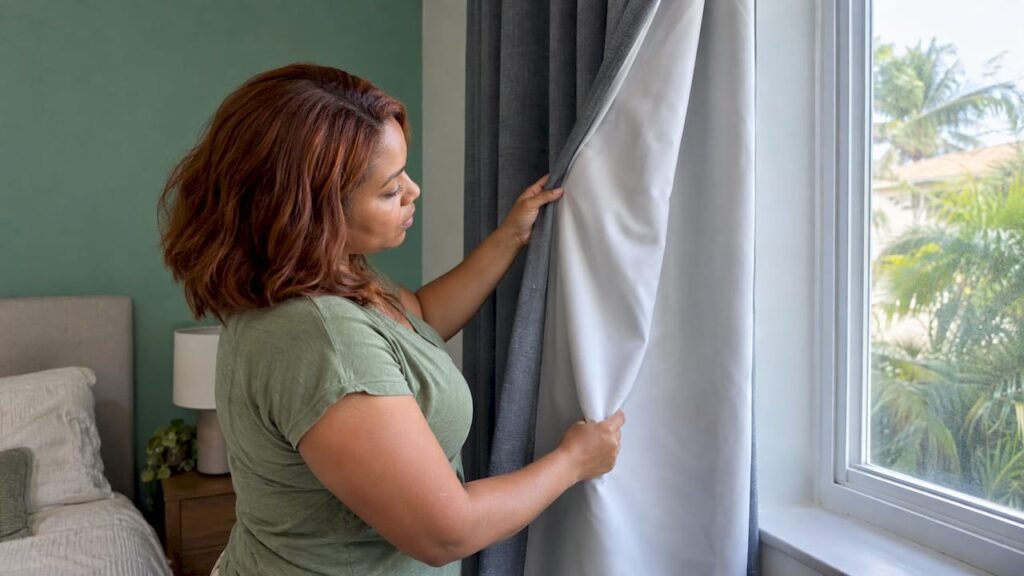
Turn a corner of the panel over and look at the backing. A fabric-type guide from April 2026 suggests checking for cracking or stiffness on the back, glued seams or bonded layers, detachable liners and metal grommets. If the backing feels brittle, a washer is the wrong tool.
This habit of looking closely before cleaning anything valuable applies well beyond curtains. A guide on inspecting fabric before cleaning makes the same point for household items: know what a piece is made of, and what it can tolerate, before you decide how to clean it.
Anything that fails the inspection, or that you are unsure about, is a candidate for professional cleaning.
What goes wrong with home washing
Most blackout curtain damage comes from a handful of repeat mistakes.
Heat. Almost all curtain shrinkage is a drying problem caused by dryer heat, not the wash. For coated blackout curtains the risk is worse: one blackout-curtain maker warns never to put coated panels in a dryer, since heat can damage the coating.
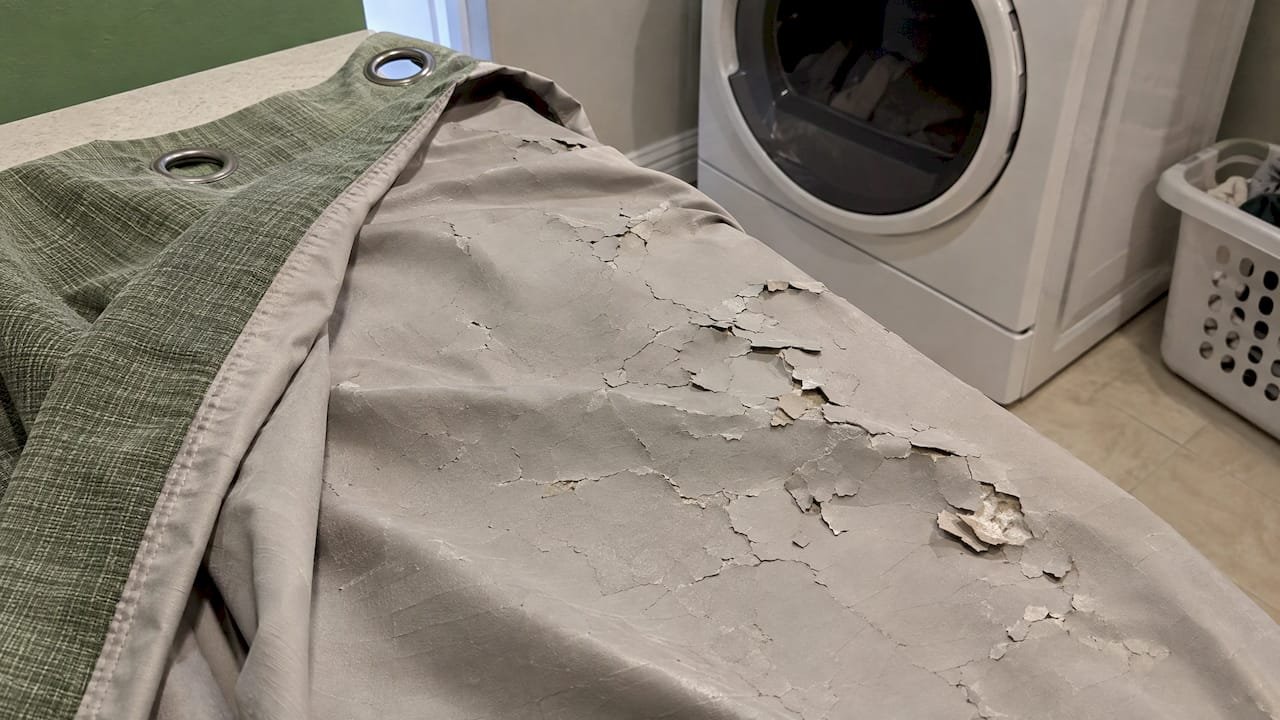
Liquid on the backing. A window-treatment maker’s care guide says never to spot clean or apply liquid of any kind to the backside of acrylic-backed or blackout fabrics, because the acrylic backing must be kept dry. The same guide says to avoid strong cleaners and disinfectants, especially those containing quaternary ammonium compounds or phenols. Many household sprays contain exactly those.
Bleach and fabric softener. Both are on the avoid list in most care guidance for curtains. Interior designers quoted by a home magazine recommend no bleach or fabric softener, light detergent and cold water for panels that can be washed.
Ironing. Direct iron heat can melt synthetic and blackout-lined fabrics. Product testers advise steaming rather than ironing these curtains.
Skipping the hardware step. Hooks, pins, clips and removable weights come off before washing, while sewn-in weights and fixed grommets stay. Forget this and the hardware can snag the fabric or scratch the drum.
The pattern is the same each time: one wrong setting, and the light-blocking layer is damaged. That is the case for having drapery cleaned by trained technicians, who work from the fabric rather than from guesswork.
How professional cleaning fits in
Professional drapery cleaning exists for panels like these. A window-treatment maker’s own care guide says that drapery and upholstery cleaning services are fabric-care experts, and that coated fabrics must be handled with care to avoid damage. Consumer testing advice points the same way for complicated pieces: dry cleaning is the choice when in doubt, especially for stitched-in pleats, swags or elaborate ornamentation, which describes many blackout drapes.
Our team is IICRC-certified, and we use eco-friendly, pet-safe cleaning solutions, which matters if your dog or toddler sleeps in the room with those curtains. Our drapery cleaning service covers homes and businesses across Miami-Dade, Broward and Palm Beach counties. If you want to understand methods, costs and what a visit looks like before booking, our curtain cleaning service guide walks through it.
Why South Florida curtains need it more often
General guidance says to deep clean curtains every three to six months. In Miami’s heat and humidity, fabric holds moisture, dust sticks, and odors settle into thick, lined panels. We cover how often local homes need it in our guide to Miami curtain cleaning frequency. Bedrooms with blackout curtains are the usual trouble spot: the panels stay closed during the day, air barely moves behind them, and the lining keeps humidity close to the fabric.
Between cleanings: keep the dust off
Routine care is what stretches the time between professional visits. Because blackout panels should not be soaked casually, dry methods are the right habit.
- Vacuum top to bottom. Use a soft brush attachment, paying attention to the rod, pleats and folds, where dust collects. A home-care editor’s in-place method starts with vacuuming from top to bottom before anything else.
- Vacuum the face side only if the back is coated. Keep moisture off the backing.
- Steam lightly. A handheld steamer lifts dust and removes wrinkles without the heat of an iron, and steaming is the method advised for synthetic or blackout-lined curtains. Keep it moving and follow the fabric’s label.
- Spot problems early. If you spot a stain, blot rather than rub, and keep liquid on the face fabric only. For a stain you cannot lift in one gentle pass, stop and have it treated professionally. Rubbing sets the stain and roughens the fabric.
- Vacuum again once the panel is dry to pick up what the steam loosened.
This routine keeps surface dust and pet hair down. It does not replace a full cleaning, because dust, body oils, humidity and airborne grime build up in the fibers. The same in-place guidance still recommends a full wash every three to six months.
If your blackout curtains are machine washable
Some blackout panels are washable, and the label will say so. In that case, the guidance across manufacturers and testers is consistent:
- Remove hooks, pins and removable weights first.
- Wash one or two panels at a time, in cold water, on the cycle the label specifies, which is usually gentle. Product testers recommend cold water and a limited load.
- Spot-test the detergent on a hidden area first, to be sure the dye does not bleed.
- Close fasteners and put the panel in a wash bag or pillowcase.
- Air dry. Never use high heat.
A research summary from one buyer’s guide reports that in a test of more than 30 cold, gentle washes with air drying, triple-weave curtains kept about 94% of their light blockage while coated curtains lost roughly 22%. Even carefully washed coated curtains wear down with every cycle, so the fewer times a coated panel goes through a machine, the longer it blocks light.
Sheer curtains need a different approach
Sheers sit in front of blackout curtains in many bedrooms and living rooms, and they have the opposite problem: they are light, loosely woven and easy to snag or discolor.
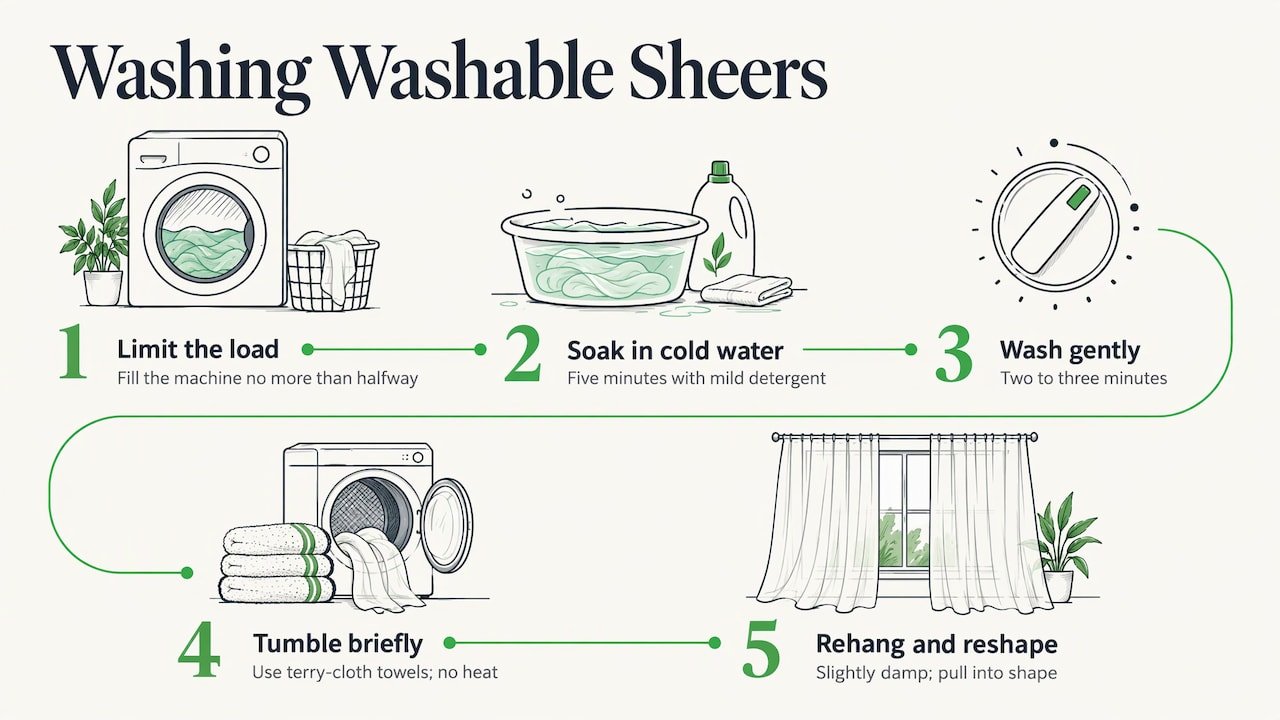
Consumer Reports advises washing sheers regularly even when they look clean, because by the time dirt shows, the fabric can already be permanently discolored. Its method for washable sheers is to fill the machine no more than halfway, soak the panels for five minutes in cold water with mild detergent, wash gently for two to three minutes, and tumble briefly with terry-cloth towels on no heat. Rehang them slightly damp and pull them into shape. A zip-up mesh bag also protects sheers and lace from snagging in the drum.
Sheers with stitched-in pleats, embroidery or trim are better handled by our drapery team. The delicate weave is the reason: a snagged thread or a stretched hem shows immediately, and cannot be fixed afterward.
What professional drapery cleaning costs
Our drapery cleaning is priced at $10 to $50 per pleat. The range reflects the fabric, the size and construction of the panel, and the pleat style. As an arithmetic illustration only: a panel with 10 pleats would fall between $100 and $500 at the ends of that range, and you would multiply by the number of panels. We confirm the figure for your specific curtains when you book.
Compare that with replacing a set of custom blackout drapes after a failed wash. Because coating damage cannot be reversed, a single mistake can cost more than several professional cleanings.
Our 21-day satisfaction guarantee applies to our cleaning services, and same-day service is available when you need curtains back on the window quickly. Many Florida homes need that: an event, a move-in, or a rental turnover does not wait.
For property managers and busy households
If you manage hotel-style rooms, offices, or rental units, blackout curtains hang in every bedroom, and each one gathers dust on a schedule. Setting a recurring interval, rather than cleaning only when something looks wrong, keeps the panels consistent and prevents odors. For households with allergies or pets, pet hair and dust collect in pleats, and a professional cleaning removes what a vacuum leaves behind.
We serve locations across the area, including Miami, Miami Beach, Fort Lauderdale and Pembroke Pines.
Our point of view
We see blackout curtains as the most misunderstood item in a window. People treat them like any other curtain, then discover the backing has cracked and the room is bright again.
Our view is simple: the label and the construction decide the method, not the other way round. A panel with a coated back should stay away from heat and from liquids on that side, and a panel with a dry-clean-only tag should go to someone who cleans fabrics for a living.
South Florida adds its own pressure. Humidity makes fabric hold moisture, and thick lined curtains stay closed for days. That is why we tailor our cleaning processes to this climate, with eco-friendly, pet-safe products and IICRC-certified technicians, so a family can sleep behind freshly cleaned curtains without worrying about what is in them.
If you are unsure what your curtains are made of, ask us before you wash anything. We would rather look at the panel first than see it after a failed wash.
Dr
Book your curtain cleaning
If your blackout curtains are due for a deep clean, or you are not sure what is safe for them, our drapery cleaning team can handle it. We clean drapery in Miami, Broward and Palm Beach counties, at $10 to $50 per pleat, with a 21-day satisfaction guarantee and same-day service available.

See the details and request a visit on our drapery cleaning page, or start from drsteemer.com.
FAQ
Can I wash blackout curtains in a washing machine?
Only if the care label allows it. Lined, coated or heavy blackout panels may not be machine washable. If the label permits it, use cold water, a gentle cycle and mild detergent, and air dry. A dry-clean-only label means the panel should go to a professional.
Can I put blackout curtains in the dryer?
No, not coated ones. Heat can crack the coating that blocks light, and the blackout effect cannot be restored once it fails. Air drying is the safe method, and rehanging the panel while slightly damp helps wrinkles fall out.
How often should curtains be cleaned?
General guidance is a deep clean every three to six months, with regular vacuuming in between. In humid South Florida homes, bedrooms with closed blackout curtains tend to need attention at the shorter end of that range.
How do I clean sheer curtains?
Use cold water, mild detergent, a gentle wash and no heat, with a mesh bag to prevent snags, as Consumer Reports describes. Sheers with pleats, trim or embroidery are better cleaned professionally.
How much does professional curtain cleaning cost?
Our drapery cleaning costs $10 to $50 per pleat. The final figure depends on the fabric, the size of the panels and the number of pleats, and we confirm it when you book.
Sources
- How to Wash Curtains and Drapes in a Washing Machine (Maytag)
- How to Wash Curtains: A Care-Label-First Guide (Deconovo)
- Wash curtains in your Samsung washing machine
- How to Clean Curtains, Blinds, and Shades (Wirecutter)
- How to wash and care for curtains and drapes (Homes and Gardens)
- How To Wash Blackout Curtains (Sleepout)
- Care and Maintenance of Window Treatments (Lutron)
- How to Clean Curtains by Fabric Type (NICETOWN)
- How to Wash Curtains Without Shrinking (CalcBold)
- Polyester Blackout Curtains: The Complete Guide for 2026 (The Decor Advisor)
- How to Clean Your Curtains (Consumer Reports)
- How to Clean Curtains the Easy Way Without Taking Them Down (The Spruce)
Recommended
- Curtain Cleaning Service: Methods, Costs and What to Expect
- Miami Curtain Cleaning: How Often Miami Homes Actually Need It
Want it done right the first time?
Our IICRC-certified team handles carpet, upholstery, tile and stone across Miami-Dade, Broward and Palm Beach, usually the same day.