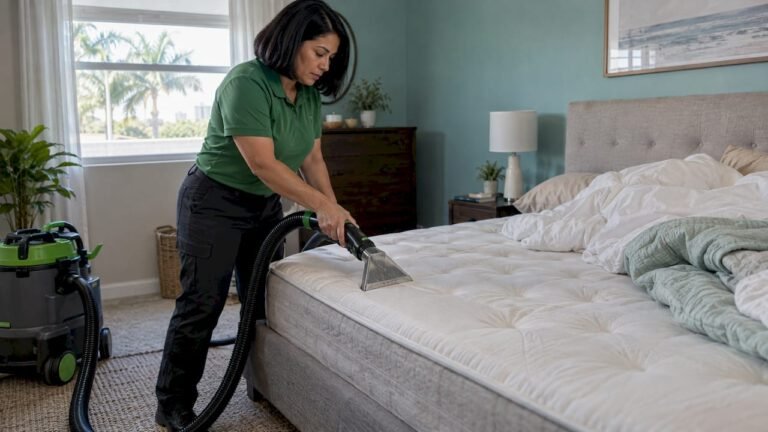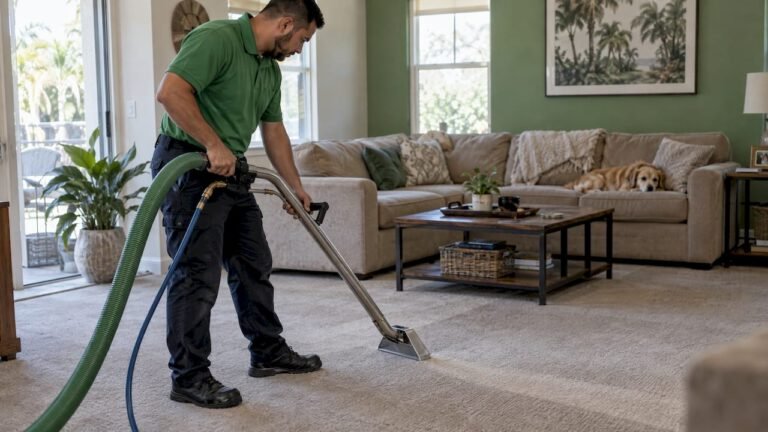
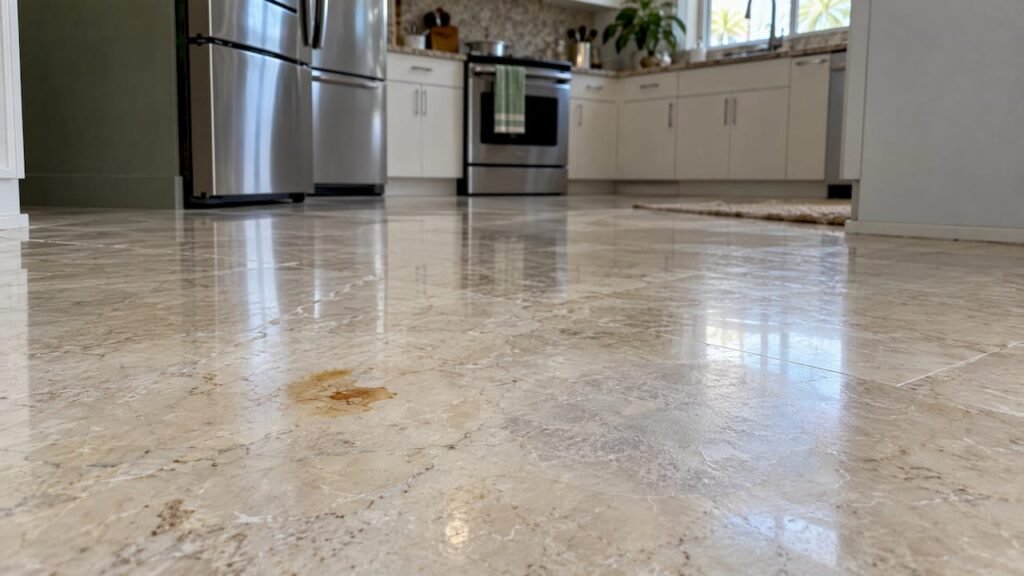
Most marble stain removal goes wrong before the first cloth touches the stone, because the mark is often not a stain at all. A dull ring left by lemon juice is an etch, a chemical burn in the finish, and no stain remover will lift it. The safest path is to identify the mark, blot and dry the area gently, and hand anything that has soaked in or dulled the surface to a stone professional. In Miami, Broward and Palm Beach counties, that is the work our IICRC-certified team does on marble floors and surfaces.
TL;DR
- A stain is darker and sits inside the stone. An etch is lighter, dull and sits in the finish. They need different fixes, and one spill can cause both.
- Blot, never wipe, then clean only with a pH-neutral cleaner or mild dish soap and dry the stone completely.
- Vinegar, lemon, bathroom cleaners, scouring powders and bleach damage marble. Sealer does not stop etching.
- Deep stains, rust, widespread dulling and anything that has not budged after gentle treatment call for professional cleaning and polishing.
- We clean and polish marble across Miami-Dade, Broward and Palm Beach counties, with same-day service options and a 21-day satisfaction guarantee.
Table of Contents
- Stain, etch or scratch: what you are actually looking at
- What to do in the first hour
- Why household stain fixes damage marble
- Match the stain to the treatment
- Etching: repairing the dull spot
- Cleaning marble floors without making more problems
- When to stop and call a professional
- Book marble cleaning and polishing with us
- Our point of view
- FAQ
- Sources
Stain, etch or scratch: what you are actually looking at
Marble is mostly calcite, a mineral that dissolves in acid and absorbs liquids. That one fact produces most of the damage homeowners and property managers see. The Natural Stone Institute, the US trade association for natural stone, draws the line this way: a stain changes the stone’s color because a substance was absorbed into it, while an etch is caused by acid left on the surface that alters the finish. Some materials, wine being the classic example, do both at once.
The quick field guide:
| Mark | How it looks | How it feels | When wet |
|---|---|---|---|
| Stain | Darker or tinted (brown, yellow, pink), soft spreading edges | Same as the surrounding stone | Stays visible |
| Etch | Lighter, dull or cloudy, sometimes a ring or drip pattern | Slightly rough or less slick | Mostly disappears |
| Hard-water film | White or gray haze | Raised or gritty | Stays visible |
| Scratch | A thin line that follows a path of travel | Catches a fingernail | Often still visible |
| Stun mark | White dot or arc with a tight outline | Usually cannot be felt | Stays visible |
These distinctions come from several stone-care guides, including Stonify’s etching guide on the wet test and Dynamic Stone Tools on scratches and stun marks. The practical point: a stain may respond to cleaning, while an etch, scratch or stun mark is a surface problem that needs the finish re-abraded.
How to inspect it properly
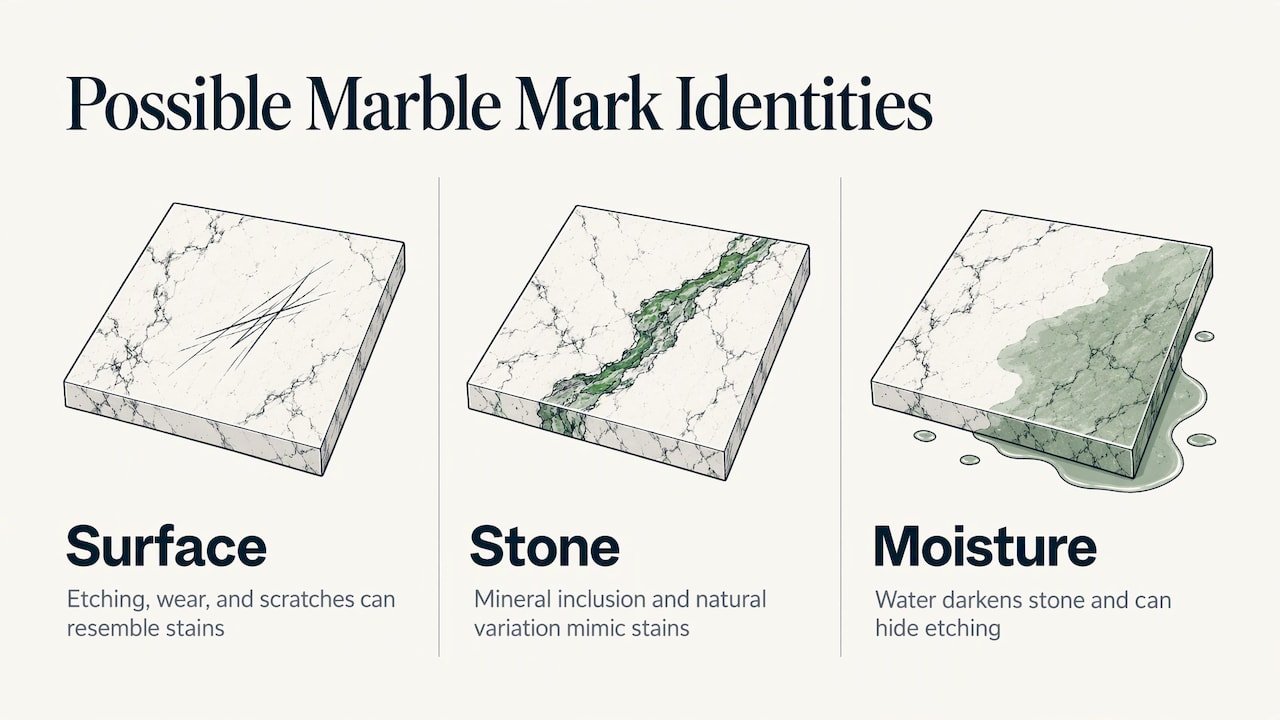
Inspect when the stone is clean and dry. The Cleaning Standard’s tile and stone manual points out that water temporarily darkens stone, fills scratches and can hide etching and haze. A wet floor can look flawless and dry out blotchy.
Then light it from the side. A flashlight held low reveals scratches, etching and swirl marks that overhead light hides. Look straight down for color, then crouch and view at an angle. An etch becomes clearer as the reflection moves across it, while a stain stays put from every angle.
The same manual offers a warning worth taking seriously: a mark called a stain may really be etching, wear, a scratch, a mineral inclusion, natural stone variation or moisture. Confirm what it is before you treat it. Treating an etch as a stain wastes time and can leave the surface less uniform than it started.
What to do in the first hour
The time between the spill and your response decides how deep the stain goes. Light-colored marble is especially prone to staining, and American Olean’s stone care guide advises cleaning spills up immediately.
- Blot, do not wipe. Wiping spreads liquid into more of the stone. Press a clean, soft cloth or paper towel on the spill and lift.
- Rinse lightly with clean water and blot again. In hard-water areas, filtered water leaves less film.
- Wash with a gentle neutral cleaner. Wirecutter recommends dish soap mixed with water at roughly one part soap to three parts water for everyday marble wipe-downs, because dish soap is pH neutral.
- Dry the surface completely with a soft microfiber cloth. Standing water leaves spots, and Bob Vila’s marble floor guide notes that some marble contains iron oxide that water can bring to the surface as rust-colored marks.
- Stop there and look again once it is dry. If the mark is gone, you are finished. If it is still there, do not escalate to stronger products.
That last step matters. Every stain-lifting trick you find online gets riskier as it gets stronger, and marble offers no do-overs.
Why household stain fixes damage marble
The top search results for this topic are full of vinegar and salt, baking soda, ammonia, acetone and boiling water. On marble, several of those are the cause of the problem, not the cure.
According to Stonify’s chemistry breakdown, lemon and lime juice and vinegar can etch polished marble within seconds, and wine and orange juice within about a minute. Most bathroom and tile cleaners are acidic enough to do the same, often severely. American Olean says even a light vinegar-and-water solution will etch many stones, and that an acid attack shows up as a dull spot in the glossy finish that cannot be removed without refinishing.
The opposite end of the scale causes trouble too. Wirecutter warns against acidic cleaners such as vinegar and Bar Keepers Friend and against alkaline ones such as baking soda and Krud Kutter. Cleaning Cubby puts the safe window for stone cleaners at roughly pH 6 to 8 and lists bleach-based cleaners, ammonia-based glass cleaners and all-purpose sprays that leave a waxy film among the products to keep off marble.
Two more points that surprise people:
- Sealer does not prevent etching. A sealer slows liquids from soaking in, so it helps against stains. It does not protect the finish from acid.
- Mixing cleaners is a safety issue, not just a stone issue. Never combine bleach and ammonia, because the combination creates a toxic gas, as SoCal Tiles cautions.
Also avoid abrasive powders, scouring creams, rough pads, metal brushes and unapproved steam equipment on marble. The same guide lists them as things never to use on stone unless approved for it.
Match the stain to the treatment
Once a mark is confirmed as a true stain, the right treatment depends on what caused it. The Natural Stone Institute sorts stains by type:
- Oil-based (cooking oil, grease, cosmetics): dissolved with solvents such as mineral spirits or acetone.
- Organic (coffee, tea, wine, food, plant material): lightened with hydrogen peroxide of a strength the Institute specifies for indoor use, with a few drops of ammonia.
- Metal (rust from a can, a plant stand or iron in the stone itself; copper from a fixture): drawn out with a poultice built around a rust remover or ammonia-based formula.
A poultice is a paste of a white absorbent powder and a cleaning agent, spread over the stain and covered with plastic. As it dries, it pulls the stain out of the stone. The Institute describes a 24 to 48 hour dry time and repeated applications for stubborn stains, and says to call a professional for deep-seated rust or stains that will not budge. The U.S. General Services Administration’s specification for historic interior marble treats poultice cleaning as controlled professional work: pre-wetting, a thick layer applied with a wood or plastic trowel, a plastic cover, a drying window set by test samples, and a low-pressure rinse. It also limits repeating the procedure.
There is a reason professionals work this way. American Olean notes that a poultice’s success depends on the stain’s nature and age, that old or deeply penetrated stains may not respond, and that a poultice can dull polished stone, which then needs a stone polish to bring the shine back. The chemical choice, the dwell time and the follow-up polish are where results are made or lost, and where a marble slab can be permanently marked.
That is why, for anything beyond a fresh spill, we recommend calling us rather than building a poultice on a countertop or a hallway floor. Our team identifies the stain, treats it, and restores the finish in the same visit.
Etching: repairing the dull spot
Etching is the most common reason people search for marble stain removal and never find an answer. The mark is not in the stone, it is the stone. Acid has eaten a microscopic layer of the polished surface, and light now scatters instead of reflecting.
The Natural Stone Institute says light etches can be worked out with marble polishing powder and a damp cloth or low-speed buffing pad, and that etched areas you cannot remove need a professional restorer. Several things push an etch firmly into professional territory:
- Widespread dulling, such as a whole kitchen island, a bathroom vanity or a traffic path on a floor, which needs a machine and diamond abrasives to blend evenly.
- Honed (matte) finishes, where polishing powder changes the look of the spot compared with the rest of the stone.
- Heavily veined marble, where a blending mistake is very hard to hide.
- Scratches and stun marks, which are cut or crushed crystals, not residue.
The SlabWise guide to marble restoration adds a sobering fact: most marble slabs are only about three-quarters of an inch to 1.25 inches thick, so aggressive grinding removes finite material. Restoration is a job for someone who knows how much stone can safely come off. Our marble polishing service page explains the process, and our guide to polishing marble floors in Miami covers what homeowners can expect.
Cleaning marble floors without making more problems
Floors collect most of their damage from grit. Sand and dirt under foot traffic act as sandpaper, and TilePro’s marble care guide says grit ground into a wet mop causes most fine scratching. A sound routine keeps stains from happening and etches from spreading:
- Dust-mop or vacuum before any wet cleaning, using an untreated dust mop and attachments that cannot scratch.
- Clean with a diluted pH-neutral cleaner made for stone, and change the rinse water often so you do not push dirt around.
- Read cleaner labels. “Safe for granite and marble” is not the same as neutral pH.
- Place mats at entrances and felt pads under furniture, and lift heavy objects rather than dragging them.
- Skip wax and “shine” products unless they are made for your stone and finish.
- Dry the floor after cleaning, especially in humid weather.
Moisture deserves special attention in South Florida. Wirecutter quotes a stone-restoration CEO saying that consistent moisture is among the biggest enemies of natural stone, causing staining and other damage, especially when sealing is overdue. The same article suggests resealing surfaces that touch water daily every six months and less-exposed surfaces such as tiled floors roughly every year. Resealing after a deep cleaning is a routine we handle as part of marble care. If you are managing a lobby, restaurant floor or multi-unit property, a regular schedule costs far less than restoring a floor that has been neglected.
If your floor combines marble with tile or terrazzo, see our marble floor cleaning in Miami page, which covers professional restoration for stone floors.
When to stop and call a professional
Call a stone professional if any of these apply:
- The mark is still there after a gentle wash and a thorough dry.
- It looks lighter or dull, not darker, which signals an etch.
- A stain has been there for days or weeks, or it came from rust, ink, oil or wine that has soaked in.
- A large area looks dull, hazy or uneven.
- Water no longer beads on the surface, which suggests the sealer has worn off.
- The “stain” follows a vein or seems to come from inside the slab.
- You see scratches, chips or cracked and loose tiles, which are structural or finish problems and not cleaning problems.
These match the triggers SlabWise and Cleaning Cubby both list for bringing in a pro. American Olean likewise recommends contacting a professional stone restoration company whenever natural stone is damaged or worn.
Book marble cleaning and polishing with us
We clean and polish marble for homes and businesses in Miami-Dade, Broward and Palm Beach counties. Our IICRC-certified technicians work with eco-friendly products, and we offer same-day and next-day booking for urgent jobs, which helps when a spill is fresh. Our 21-day satisfaction guarantee backs the work.

Start at our marble cleaning and polishing page, or reach us through drsteemer.com to describe the mark and the surface. Tell us what spilled, how long ago, and whether the finish is polished or honed, and we will point the visit in the right direction.
Our point of view
Most of the marble we are asked to rescue was damaged by a cleaning attempt, not by the original spill. A vinegar wipe on a dull ring, a scouring pad on a dark spot, a bathroom spray on a vanity top: each turns a small problem into a bigger one.
Our approach starts with one question: what kind of mark is this? A stain, an etch and a scratch look alike from standing height and behave differently under treatment. We identify the mark first, then choose a cleaner or a polishing step to match it. That is why we offer both cleaning and polishing for marble and terrazzo in one visit.
South Florida’s heat and humidity put constant moisture pressure on stone floors. Our processes are designed for that climate, and we use eco-friendly, pet-safe products because the families and businesses we serve walk, play and work on these floors every day.
If you are unsure whether a mark is fixable, ask us before you try anything. Our team will tell you what the stone needs.
Dr
FAQ
Can baking soda or vinegar remove stains from marble?
Not safely. Vinegar is acidic and etches polished marble, leaving a dull spot. Baking soda is alkaline, and Wirecutter lists it among the products to avoid on marble. A pH-neutral stone cleaner or mild dish soap is the safe starting point, and anything beyond that is best left to a professional.
How do I know if my marble is stained or etched?
Dry the area and look at it from a low angle with a flashlight. A stain is darker and feels the same as the surrounding stone. An etch is lighter and duller and may feel slightly rough. A wet cloth will make an etch look better for a moment, but a stain stays visible.
Can etched marble be repaired?
Yes. An etch is a change in the finish, so repair means re-polishing the surface. Light etches on polished marble can sometimes be buffed with polishing powder. Widespread etching, honed finishes and veined marble are best handled by a professional with the right equipment, like our marble polishing team.
What cleaner should I use on marble floors?
Use a pH-neutral cleaner made for natural stone, or mild dish soap diluted in water, then dry the floor. Avoid vinegar, citrus, bleach, bathroom cleaners and scouring powders. Dust-mop first to keep grit from scratching the surface.
How long should I wait before calling for help on a stain?
Call as soon as gentle cleaning has not worked. Stains that sit longer soak deeper and become harder to draw out. For a fresh spill, blot it right away and dry the area while you arrange a visit.
Sources
- Natural Stone Institute: remove stains from stone
- Stonify: marble etching and restoration
- Dynamic Stone Tools: stun marks in marble
- The Cleaning Standard: tile and stone manual
- American Olean: natural stone care instructions
- Wirecutter: cleaning marble, granite and limestone
- Bob Vila: how to clean marble floors
- Cleaning Cubby: neutral floor cleaner for marble and stone
- SoCal Tiles: natural stone care and maintenance guide
- GSA: cleaning and repolishing of interior historic marble
- SlabWise: marble countertop restoration
- SlabWise: remove stains from marble countertops
Recommended
- Marble Polishing Service: Process, Cost and Care
- How to Polish Marble Floors: A Guide for Miami Homeowners
- Best Marble Polishing Techniques for Broward and Miami-Dade
Want it done right the first time?
Our IICRC-certified team handles carpet, upholstery, tile and stone across Miami-Dade, Broward and Palm Beach, usually the same day.