The safest way to clean terrazzo is simple: dust mop daily, damp mop or machine-scrub with a pH-neutral cleaner, and keep acids, bleach, vinegar and ammonia off the floor. Most damaged terrazzo is not worn out by foot traffic. The wrong cleaner dulled it. This guide covers the routine, the stains that tend to show up in South Florida homes and businesses, when polishing makes sense and what a real restoration involves.
TL;DR
- Dust mop every day. Grit tracked in from outside is the main thing that scratches and dulls terrazzo.
- Use only neutral-pH cleaners. Vinegar, bleach, ammonia, degreasers and acidic tile cleaners can etch the marble chips and break down sealer.
- Clean spills right away and ask your installer or a terrazzo specialist which sealer is on your floor before you strip or reseal anything.
- Dull, scratched or etched terrazzo usually needs machine polishing, not stronger chemicals. Cracks and deep damage call for a restoration crew.
- In Miami, Broward and Palm Beach counties, we clean and polish terrazzo for homes and businesses.
Table of Contents
- What terrazzo is and why it needs specific care
- The daily and weekly routine
- What not to put on terrazzo
- Removing stains and pet accidents
- Sealing: what it does and how often
- When cleaning is not enough: polishing
- Scratches, etching and cracks: when it is restoration
- A realistic maintenance calendar
- Perspective: why South Florida terrazzo needs a pro eye
- Get your terrazzo cleaned and polished in South Florida
- FAQ
- Sources
What terrazzo is and why it needs specific care
Terrazzo is a composite floor: chips of marble or other aggregate set in a binder, then ground and polished flat. The binder matters for care. The National Terrazzo and Mosaic Association (NTMA) describes three binder types: Portland cement (the original), polyacrylate-modified cement and epoxy resin, which is the most common today.
That difference changes how sealer works. According to the NTMA’s 2025 systems reference guide, the cement binder in Portland cement systems is the part that benefits most from primary protection. In epoxy systems the binder is non-porous, so sealers mainly protect the aggregate and enhance the look of the surface.
Marble chips are calcium carbonate, which acids dissolve. That is why a cleaner that seems harmless on ceramic tile can leave dull, cloudy patches on terrazzo. If you are not sure what you have, an older Miami home with a terrazzo floor from the mid-century is often cement-based, while a newer commercial lobby is usually epoxy. An installer’s records or a specialist’s inspection will settle it.
The daily and weekly routine
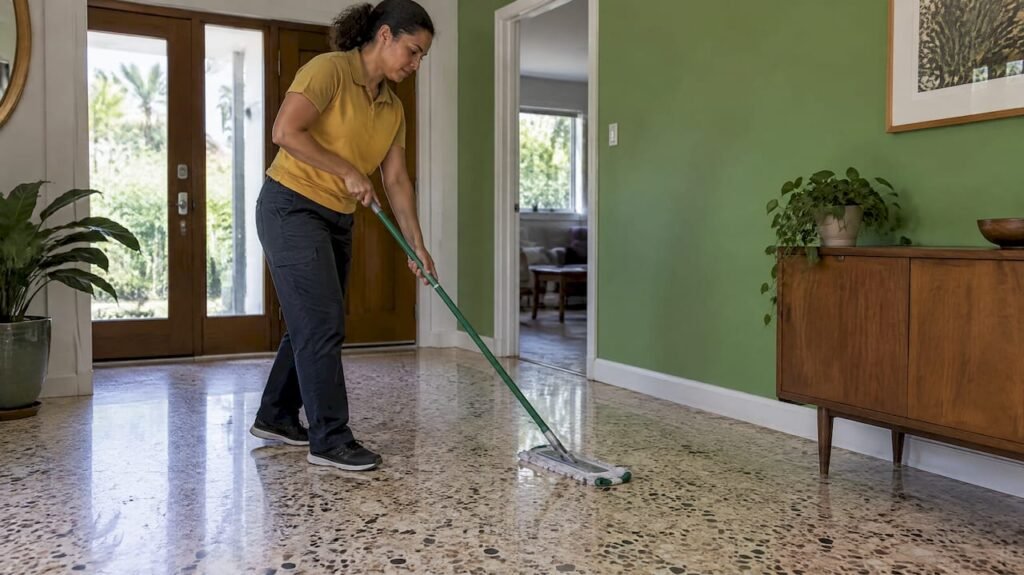
The NTMA’s guidance is consistent: daily dust mopping, weekly damp mopping of lightly soiled floors with a neutral cleaner, and machine scrubbing for heavily soiled floors. The International Masonry Institute adds that daily dust mopping and vacuuming reduce the grit that acts as an abrasive underfoot.
Step by step
- Dust mop daily. Use a clean, dry, untreated dust mop. In homes with sliding doors to a patio, do the entry zones first.
- Damp mop weekly. Mix a pH-neutral stone and tile cleaner according to the label. Keep the floor wet while you work so dirt does not dry back onto the surface.
- Rinse. The NTMA says to mop up residue with clean water before it dries, then let the floor dry and buff with a soft dry brush.
- Scrub larger or dirtier areas with a machine. For restaurants, offices, lobbies and big open-plan homes, an auto-scrubber is recommended for larger areas. The NTMA’s maintenance brochure says to scrub at least once a week with clean water and a white pad and notes that diamond-impregnated pads are not recommended for routine scrubbing.
- Dust mop again after polishing or scrubbing. Sherwin-Williams’ terrazzo maintenance guide lists damp mopping, polishing with a pad brush to remove scuffs, and dust mopping afterward as periodic maintenance.
New floors
A newly installed floor carries construction dust. The NTMA suggests scrubbing new floors about once or twice a week for the first two to three months. After that, move to the weekly rhythm above, adjusted for traffic.
Monthly refresh
Laticrete’s technical datasheet says monthly cleaning is often a simple scrubbing wash and rinse with a neutral-pH stone and tile cleaner. That is a good schedule for a busy household: a more thorough pass once a month, with the dust mop doing the work in between.
What not to put on terrazzo
This is where most floors get hurt. The NTMA says to use only neutral-pH materials when scrubbing or mopping, and to avoid degreasers, bleach, vinegar, ammonia and other household chemicals. Also on its avoid list: purely surface waxes, all-purpose sealers, and all-purpose cleaners containing water-soluble inorganic or crystallizing salts, harmful alkali or acids.
Laticrete says that highly alkaline, acidic, ammonia-based or abrasive cleaners, or bleach, may damage terrazzo tile and degrade the sealer, which hurts its stain resistance. Its recommendation is a pH-neutral cleaner formulated for stone and tile.
| Product or tool | Safe on terrazzo? | Why |
|---|---|---|
| pH-neutral stone and tile cleaner | Yes | Cleans without attacking marble chips or sealer |
| Vinegar, lemon, acidic tile or grout cleaner | No | Acid dissolves calcium carbonate and leaves etched, dull spots |
| Bleach, ammonia | No | Can damage the surface and degrade the sealer |
| Degreasers and harsh all-purpose cleaners | No | Often alkaline or contain salts the NTMA says to avoid |
| Wax | No | The NTMA lists purely surface waxes among the products to avoid |
| White scrubbing pad | Yes | Recommended by the NTMA for routine scrubbing |
| Aggressive black pad | No | The NTMA warns it may unintentionally sand or grind the floor |
| Steel wool, abrasive powders | No | The IMI warns abrasive treatments can leave terrazzo open to accelerated weathering |
Sherwin-Williams adds a practical point: ask the contractor who installed your floor which neutral cleaner and sealers suit it, and get a local terrazzo contractor’s opinion before trying miracle products. It also points out that most maintenance cost is labor, not product.
Removing stains and pet accidents
Terrazzo is hard, but a stone chip or an unsealed cement binder can still absorb liquids. The NTMA stresses that spills must be cleaned immediately to avoid stains from repeated or long exposure, and that even standing water can eventually damage some sealers.
For pet owners in a humid climate, that means wiping urine, spilled drinks and tracked-in mud as soon as you see them, with a neutral cleaner and clean water, not a vinegar spray. Cleaning up fast protects the sealer, and the sealer is what protects the floor.
Set-in stains: the poultice method
When a stain has soaked in, wiping will not lift it. M3 Technologies’ care guide explains that most stains on natural stone, terrazzo included, come out by poulticing: a suitable powder is mixed with a liquid cleaning agent, spread about 1/4 inch thick so it overlaps the stain by roughly an inch, covered with plastic and left to dry for 24 to 48 hours. Hard stains can take up to five applications.
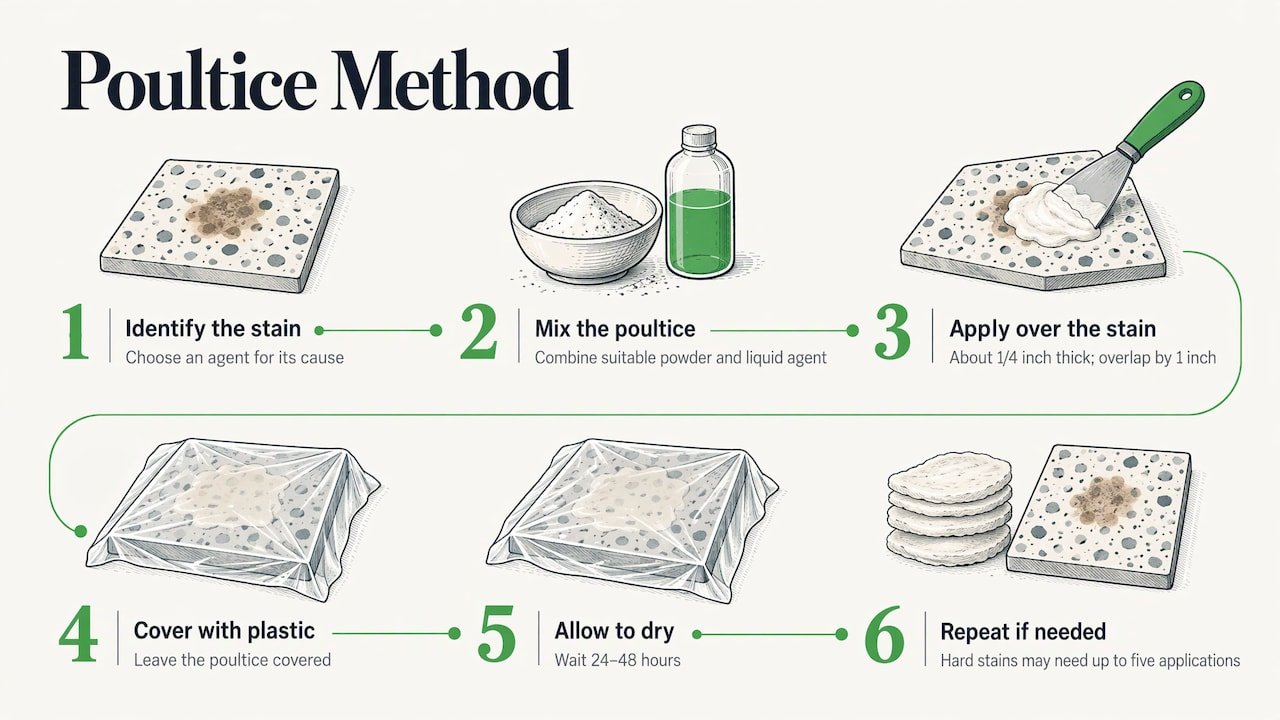
The same guide stresses that the first step is identifying what caused the stain, since each type needs a particular agent to dissolve it. Oil, rust, ink, coffee and pet stains are not interchangeable. If you cannot tell what caused the mark, or the spot is on a large, high-visibility floor, that is a good moment for a professional.
Preventing the next stain
This Old House recommends a few habits: clean spills fast, avoid dragging heavy objects, put felt pads under furniture legs, and place mats at entrances to trap dirt and moisture. In South Florida, where rain and humidity follow people indoors, entry mats do a lot of the work.
Sealing: what it does and how often
The NTMA highly recommends applying a sealer right after the final polishing and says water-based sealers are the most commonly recommended, applied per the manufacturer’s instructions. Sealers should meet the applicable slip-resistance requirement.
Sherwin-Williams says a new floor needs two or more coats of water-based acrylic sealer, which should give a good sheen for 45 to 60 days before more coats are needed. If the finish wears in traffic lanes, it recommends a wet mop with an all-purpose cleaner used per label instructions.
The NTMA’s maintenance brochure adds two cautions. Properly maintained floors rarely need stripping, and not every sealer is strippable, so check with the sealer supplier first. Using a stripper on an unknown finish is how floors get ruined.
After cleaning, protecting natural stone with the right sealer is a topic worth understanding in general; this guide to sealing natural stone tile shows the principles of sealing a porous stone, even though terrazzo has its own sealer requirements.
When cleaning is not enough: polishing
If a floor has been cleaned properly and still looks flat, hazy or scuffed, the surface needs mechanical work, not another product. The IMI says deep cleaning with an electric floor scrubber and pH-neutral cleaner, followed by spray buffing, can restore shine lost to foot traffic and reduce the need for aggressive cleaning or stripping and resealing.
For gloss, This Old House suggests a specialized terrazzo polish every few months applied by soft cloth or machine buffer, plus professional polishing annually or every other year depending on traffic. A home with a few people and a rug at the door will sit at the long end of that range. A restaurant or a shop will not.
The real polishing process is machine work. Laticrete’s surface care guide describes refinishing polished terrazzo with polishing powders in a sequence of grits from 180 up to 800, using a weighted floor machine with a natural hair or white nylon pad. That is not a weekend mop job, which is why the result of a trained crew looks so different from a hand-buffed floor.
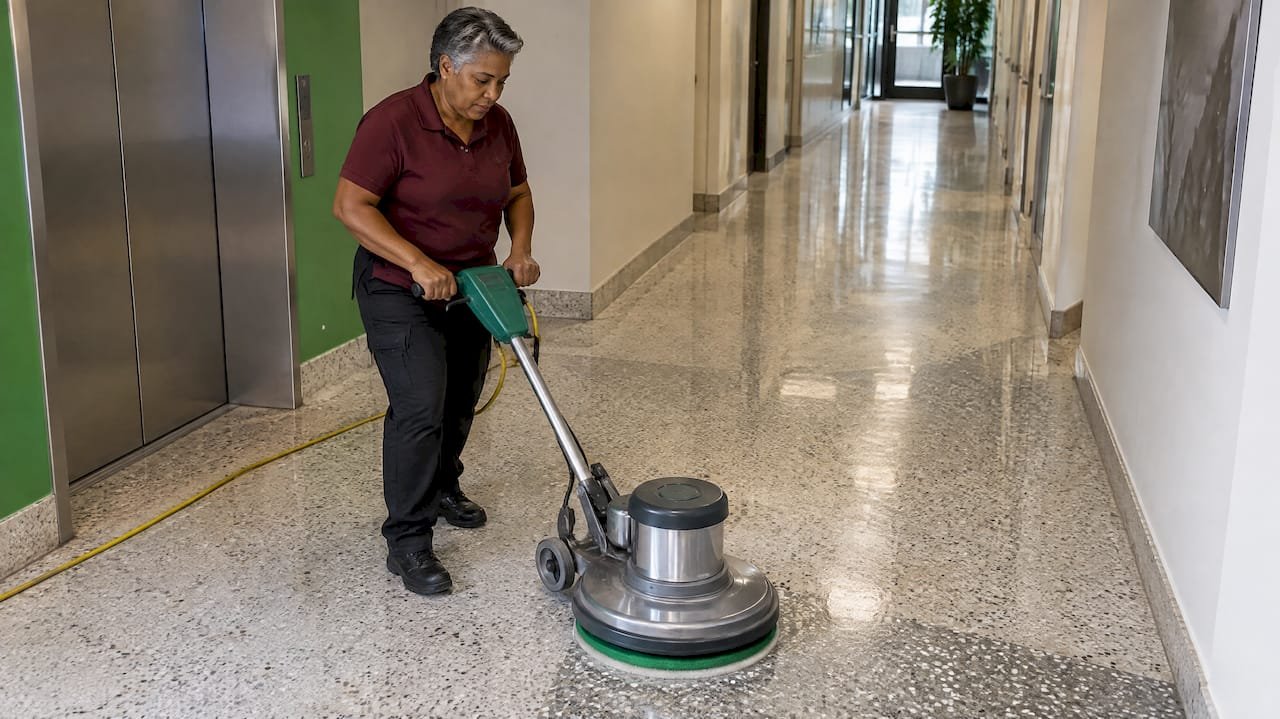
If you want to see what this looks like in our area, our page on terrazzo floor polishing in Miami explains how floors are ground and polished, and our guide to restoring marble, granite and terrazzo in Hollywood, FL covers mixed stone surfaces.
Scratches, etching and cracks: when it is restoration
Not every flaw is the same:
- Light scuffs and traffic haze: usually fixed by deep cleaning and buffing.
- Etch marks (dull rings left by acid): need honing and repolishing, since the surface of the chip has been dissolved.
- Scratches: shallow ones polish out. Deeper ones need grinding.
- Cracks and chips: need repair before any polishing.
The NTMA’s restoration specification classifies hairline cracks as under 1/32 inch. Cracks are cleaned and filled with resin, using aggregate if the crack is wider than 1/4 inch. The process then includes wet grinding with diamonds of 50 grit or higher, cement or epoxy grouting, curing for at least 12 hours at 70 to 80°F, fine grinding with 120-grit carborundum or 200-grit resin-bond diamond, and sealing per the sealer maker’s directions.
That sequence is why restoration is a crew-and-equipment job. It also explains why the cheapest fix is usually the one you do early: keep the floor clean with neutral products and you may never reach the grinding stage.
A realistic maintenance calendar
No single schedule fits every floor, but this one follows the sources above:
| Frequency | Task | Source of the guidance |
|---|---|---|
| Daily | Dust mop; wipe spills immediately | NTMA, IMI |
| Weekly | Damp mop with neutral cleaner, or machine scrub with a white pad | NTMA |
| Monthly | Wash and rinse with a neutral stone and tile cleaner | Laticrete |
| Every few months | Apply terrazzo polish if you want higher gloss | This Old House |
| Every one to two years | Professional polishing, depending on traffic | This Old House |
| As needed | Reseal per the sealer maker’s directions | NTMA |
Perspective: why South Florida terrazzo needs a pro eye
We see the same pattern in Miami, Broward and Palm Beach homes. A terrazzo floor looks dull, someone reaches for vinegar or a bathroom cleaner to brighten it, and a few months later the floor is cloudier than before.
Humidity makes that worse. Moisture and salty, sandy foot traffic mean grit and film build up quickly, and a floor that never gets a proper neutral-pH rinse can look gray even when it is not worn.
Our approach is to treat the floor as stone. We clean with products designed to be gentle on it, and when a floor needs more than cleaning, our IICRC-certified team handles polishing as a separate step with the right equipment. We would rather bring back the surface you already have than let a bad cleaner force a bigger job later.
If you manage a property, the same logic holds at scale: a steady maintenance routine is cheaper than a restoration grind.
Dr
Get your terrazzo cleaned and polished in South Florida
We clean and polish terrazzo for homes and businesses in Miami, Broward and Palm Beach counties. Our team is IICRC-certified, we use eco-friendly, pet-safe products, and we back our work with a 21-day satisfaction guarantee. Same-day and next-day booking options are available for urgent jobs.

If your floors also include grout lines, bathrooms or entryways in tile, our tile and grout cleaning service handles them in the same visit window. For terrazzo specifically, start with our terrazzo floor polishing page, or visit Dr. Steemer to ask for a quote for your property.
FAQ
Can I use vinegar and water to clean terrazzo?
No. The NTMA lists vinegar among the products to avoid on terrazzo. The marble chips are calcium carbonate, which acid dissolves, so vinegar can leave dull, etched patches. Use a pH-neutral stone and tile cleaner instead.
How often should terrazzo floors be cleaned?
Dust mop daily and damp mop weekly, according to the NTMA. In busy commercial spaces, scrub with a machine and a white pad at least weekly. A monthly wash and rinse with a neutral cleaner keeps residue from building up.
Does terrazzo need to be sealed?
The NTMA highly recommends sealing right after final polishing, with a water-based sealer applied per the manufacturer’s instructions. Epoxy terrazzo has a non-porous binder, so its sealer mainly enhances appearance, while cement-based floors gain real protection from it. Check which one you have before resealing.
How do I remove a stain from terrazzo?
First identify what caused it, then wipe fresh spills with neutral cleaner and clean water. For stains that have soaked in, a poultice left on for 24 to 48 hours is the standard stone method, and difficult marks can take several applications. If you are unsure, have a professional look at the floor.
When should I call a professional?
Call when the floor stays dull after proper cleaning, when you see etching, deep scratches or cracks, or when you have a large floor with an unknown sealer. Polishing and crack repair use grinding and polishing equipment that regular cleaning tools cannot replace.
Sources
- The Care of Terrazzo, NTMA (2019)
- NTMA Maintenance brochure (revised 2023)
- NTMA Systems Reference Guide: Terrazzo (2025)
- NTMA Restoration of Terrazzo (2021)
- Terrazzo Maintenance Guide, Sherwin-Williams
- STONETECH Maintenance & Care for Terrazzo Tile, Laticrete
- Surface Care Resource Guide, Laticrete
- Terrazzo Restoration, International Masonry Institute
- Care and Maintenance Guide, M3 Technologies
- How to Restore Terrazzo Floors, This Old House
- How to Seal Travertine Tile, SurfacesGalore
Recommended
- Marble Polishing Service: Restore Your Floors to Perfection
- Terrazzo Floor Polishing in Miami, FL
- Marble Polishing Service: Process, Cost and Care
- How to Polish Marble Floors: A Guide for Miami Homeowners
Want it done right the first time?
Our IICRC-certified team handles carpet, upholstery, tile and stone across Miami-Dade, Broward and Palm Beach, usually the same day.